
You’re folding tiny onesies, choosing names, and wondering whether your future baby will have your eyes, your partner’s curls, or the dimples that run through your family. Those guesses can be exciting, especially when every old photo seems to offer another clue.
This guide shares 10 realistic ways to estimate what your future child may look like, including studying family traits, comparing parents’ features, and using a height estimate based on parental stature. However, no chart, ultrasound, AI-generated baby image, or consumer DNA test can create an exact portrait.
A child’s appearance develops through many genes, random gene combinations, growth, and some environmental influences, so siblings can look surprisingly different. As you read, you’ll learn which clues are useful, which popular myths need a reality check, and why a newborn’s features may change during the first months and years. For more context, explore these factors that influence a baby’s appearance before comparing your family traits, then begin with the most dependable clues. (Watch a genetics-based baby appearance guide on YouTube)
What Your Future Child Will Look Like Starts With More Than One Gene
A child receives a new genetic mix from both parents, so appearance rarely follows a simple copy-and-paste pattern. Many visible traits are polygenic, meaning two or more genes help shape them. Height, skin pigmentation, eye color, and hair color can all develop from several genetic influences working together.
That is why a child may share your smile but have your partner’s hair texture, a grandparent’s eye color, or a completely unexpected combination. The National Human Genome Research Institute’s genetics glossary explains that polygenic traits don’t follow the simple dominant-and-recessive pattern often shown in school charts.
Age and growth also change the way traits appear. Nutrition, general health, and sun exposure can affect height, skin tone, hair, and other visible features. Genetics can help estimate chances and broad family patterns, but it can’t guarantee a final appearance.
Study Both Sides of the Family for Stronger Clues
Family resemblance is one of the most practical ways to guess what your future child may look like. Start with both parents, then look across several generations. Your baby’s possible features may appear in grandparents, siblings, aunts, uncles, and cousins.
A trait can seem to skip a generation before appearing again. Light eyes, curly hair, a widow’s peak, or a particular chin shape may show up in a grandparent even when neither parent has the exact feature.

Instead of focusing on one memorable relative, make a simple family trait list. Include common hair colors and textures, eye colors, facial features, height ranges, and changes that appeared with age. Patterns across several relatives give you better clues than a single resemblance.
You can also learn more about inherited newborn hair traits when considering why a baby’s hair at birth may not match its later color or texture.
Family history shows possibilities, not promises. A child’s appearance says nothing about their personality, health, behavior, or worth.
Use Baby-Feature Calculators as Fun Probability Tools
Online baby-feature calculators may combine parental details to estimate traits such as eye color, hair color, dimples, or height. They can be entertaining, but their results depend on the assumptions built into each calculator.
Before entering information, check whether the tool explains its method and uses careful language such as “possible” or “estimated.” Avoid any service that promises an exact baby image, asks for private genetic data, or charges for certainty.
A calculator can start a playful conversation between parents, but it can’t replace genetic counseling or create a reliable portrait of your future child. Treat the result as a guess, then leave room for nature to surprise you.
Estimate Eye Color, Hair, and Skin Tone Without Overpromising
Eye color, hair, and skin tone are among the first traits parents picture when they imagine a future child. Family photos can offer useful clues, but these features come from several genes and may shift as a child grows. Use family patterns to estimate broad possibilities, not to create a fixed prediction.
Make a Broad Eye-Color Guess From Family Patterns
Eye color is often discussed with a simple chart that labels brown as dominant and blue as recessive. That chart can introduce basic inheritance, but it leaves out much of the real picture. Genes such as OCA2, HERC2, SLC24A4, SLC24A5, and TYR work together to influence melanin in the iris. The result is a continuum, as explained in this MedlinePlus eye-color guide.
Brown eyes may be more likely when dark eyes are common on both sides of the family. Blue or gray eyes become more possible when light eyes appear among parents, grandparents, siblings, or other close relatives. Green and hazel eyes can also occur through different combinations of pigment and are difficult to predict with a basic chart. Two brown-eyed parents can have a light-eyed child if both carry relevant variants. Two blue-eyed parents also don’t make one particular shade absolutely certain, especially when you consider the many genes involved.
Look beyond the parents before making your guess. A grandparent with green eyes or a sibling with hazel eyes may reveal possibilities that aren’t obvious from the parents’ features.
A newborn’s eyes may not show their final color. As pigment develops during early childhood, blue-gray eyes may become greener, hazelier, or browner. The first shade you see is an early clue, not a promise.
Look at Hair Color and Texture as Separate Traits
Hair color and hair texture don’t always travel together. A child may inherit a family shade while developing a different curl pattern, strand shape, thickness, or density. MC1R variants are strongly linked with red hair, and red hair becomes more likely when both parents carry relevant variants. Still, carrying those variants doesn’t guarantee that a child will have red hair.
Try a family-photo exercise before using a calculator. Compare each parent’s natural hair color, curl pattern, strand thickness, and changes during childhood. Notice whether relatives’ hair darkened, lightened, straightened, or became curlier over time. You can also review these details alongside information about baby hair color and texture genetics.
Baby hair can shed after birth, grow back with a different texture, or change color as pigment production develops. Early hair is only one snapshot of a trait that may keep changing.
Understand Why Skin Tone Has a Wide Range
Skin tone is a polygenic, additive trait. Many gene variants help control melanin production, including variants in SLC24A5, SLC45A2, and TYR. Children often fall within the range seen across their family, yet they may be lighter or darker than either parent.
This is especially common in families with different skin tones. A child’s complexion can change during infancy and childhood, while sunlight can temporarily darken visible skin. Sunscreen, protective clothing, and shade remain important for every child, regardless of skin tone. No shade is better than another, and inheritance offers a range of possibilities rather than a preferred outcome.
Use Family Features to Picture Your Future Child’s Face and Smile
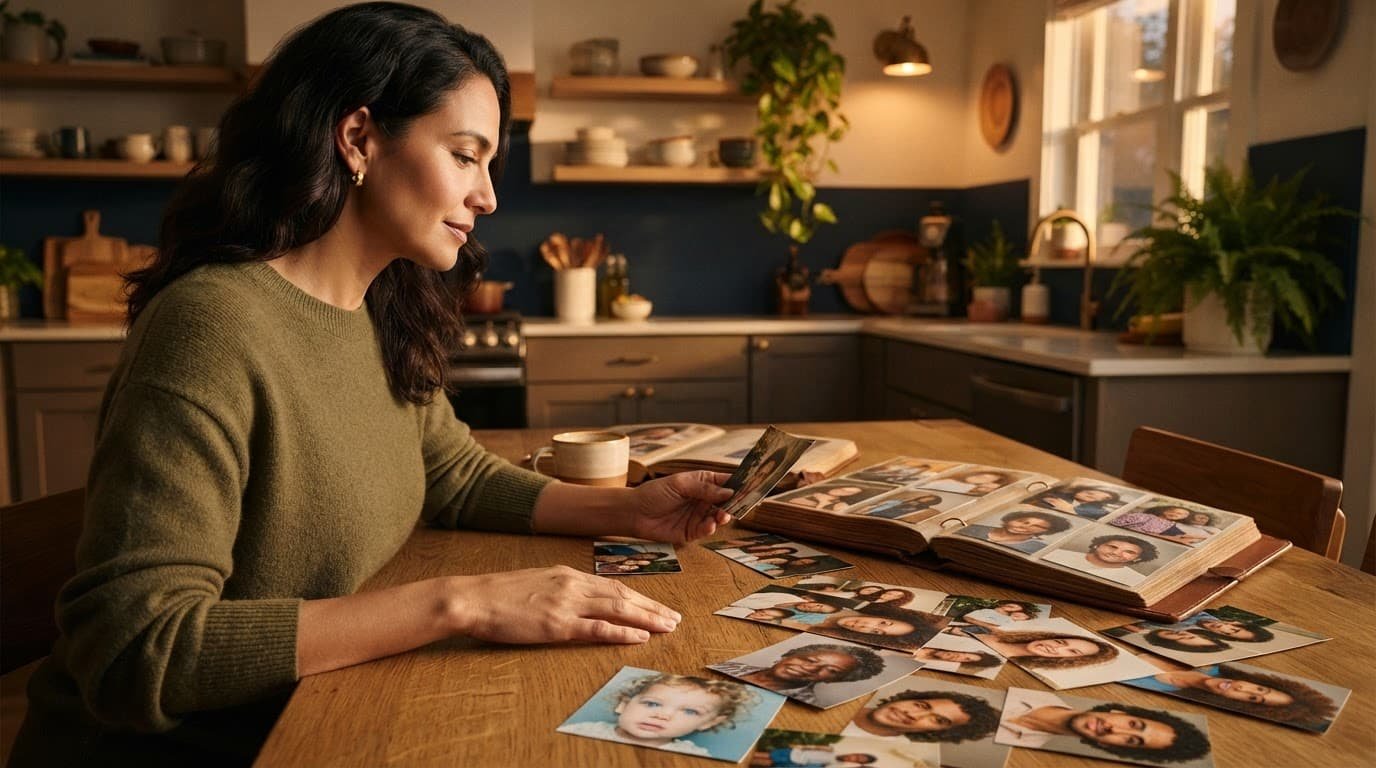
Family photos can offer charming clues about a future child’s appearance, especially when you compare relatives at similar ages. Still, resemblance works more like a shuffled photo album than a prediction formula. A child may have one parent’s smile, a grandparent’s nose, and a face shape that belongs entirely to them.
Compare Smiles, Chins, Noses, and Other Family Features
Start with childhood photos of both parents, grandparents, siblings, aunts, uncles, and cousins. Try to compare pictures taken at similar ages, since baby cheeks, missing teeth, and changing hairstyles can make relatives look very different.
Look for features that appear across several family members:
- A wide or narrow smile may repeat through generations.
- Cheek fullness and the way someone smiles can create a familiar family look.
- Chin shapes, lip contours, and forehead proportions may appear in more than one relative.
- Noses can share general traits, such as a rounded tip or a higher bridge, without matching exactly.
- Jawlines and overall face shapes often become clearer as children grow.

Facial features are shaped by many genes, along with bone growth, teeth, muscle development, and facial expressions. Research on the genetics of facial features includes the chin, cheeks, eyes, forehead, lips, and nose, but it doesn’t offer a dependable way to forecast one child’s complete face.
Exact nose shape and facial structure cannot be predicted reliably from family photos or simple inheritance charts. Instead, use your comparisons to collect possibilities. Circle repeated patterns, then leave plenty of room for an unexpected combination.
Avoid describing features as flaws or ranking anyone’s appearance. A child’s face doesn’t need to match a family ideal to be beautiful, healthy, or worthy of love. Even babies who look strongly like one parent may develop different cheek contours, jawlines, or smiles later.
Treat Dimples and Widows’ Peaks as Fun Possibilities
Dimples, widow’s peaks, and cleft chins often appear in basic genetics lessons because they seem easy to label. However, the science is less certain than those classroom charts suggest.
Dimples are linked to cheek muscle structure and are often modeled as a dominant trait. MedlinePlus Genetics explains that they tend to run in families, yet researchers haven’t confirmed one simple inheritance rule. Therefore, one parent having dimples doesn’t guarantee that a child will have them.
Widow’s peaks and cleft chins also may appear in families, but their inheritance patterns aren’t perfectly predictable. Treat these traits as playful clues, not promises. A dimple may become visible when a child smiles, fade with age, or appear alongside a face shape no one expected.
For a related look at how infants study familiar faces, read about why babies stare at parents’ faces. Resemblance may emerge gradually as expressions, teeth, and facial bones change throughout childhood.
Predict Height and Body Build With Better Context
Height is one of the more measurable inherited traits, but even a careful estimate gives you a range rather than a guaranteed result. Parents’ stature offers a useful starting point, while nutrition, sleep, health, hormones, and puberty timing also shape how a child grows.
Try the Mid-Parental Height Formula for a Rough Range
Clinicians may use the mid-parental height formula to estimate a child’s adult height based on the measured heights of both parents. One common version uses these simple steps:
- Add the mother’s height and the father’s height.
- Add 5 inches for a boy or subtract 5 inches for a girl.
- Divide the total by 2.
- Treat the result as the midpoint of an expected range.
For example, if both parents are 68 inches tall, the estimate for a boy would be 70.5 inches, while the estimate for a girl would be 65.5 inches. The American Academy of Pediatrics describes a typical target range of about 4 inches above or below the midpoint. You can review the AAP’s child height guidance before using any online calculator.
This formula uses average sex-based assumptions, so the result may not fit every child or family. Use a reputable pediatric source, record the units carefully, and avoid treating the number as a target your child must reach. Children can grow outside the expected range and still be healthy.

Remember That Growth Depends on More Than DNA
Inherited potential works alongside a child’s living conditions and overall health. Adequate nutrition supplies energy and nutrients for bone and tissue growth, while regular sleep supports the body’s normal recovery and hormone activity. Chronic medical conditions, hormone differences, certain medications, and unusually early or late puberty can also affect growth pace and final height.
Body build deserves the same care. Parents may pass along tendencies related to frame, muscle distribution, or body proportions, but parental size alone cannot predict a child’s future weight or appearance. Every child’s growth pattern is individual.
Rather than comparing your child with siblings or classmates, follow their growth trend over time. Regular visits help a pediatric professional assess height, weight, development, and changes on a growth chart. You can also review these signs of a toddler growth spurt while keeping the focus on steady, healthy development.
Choose Safe Ways to Explore Genetics and Avoid False Promises
Curiosity about a future child’s features is natural, but genetics tools need clear boundaries. Family observation can suggest possibilities, while calculators offer entertainment. Medical concerns require qualified guidance, not a polished prediction on a screen.
Know What Consumer DNA Tests Can and Cannot Tell You
Consumer DNA services may estimate ancestry or help identify biological relationships through family matching. They can also report selected traits, but those reports don’t create a dependable portrait of a future child. Results depend on the traits tested, the reference groups used, and the many genes involved in human appearance.
An ancestry estimate is not a forecast of your child’s eyes, face, skin tone, height, or personality. Even when a service tests a trait linked to eye color or hair, it usually examines only part of the genetic picture. MedlinePlus explains the limits and privacy risks of direct-to-consumer genetic testing.
Before ordering a test, review:
- Which traits and variants the service actually tests.
- How the company stores, shares, and deletes DNA data.
- Whether research participation requires separate consent.
- Whether the laboratory or data processing occurs outside your country.
- What happens to your data if the company changes ownership.
- Whether pregnancy, minors, or family matching create extra consent concerns.
DNA information can reveal details about biological relatives as well as you. During pregnancy, discuss any test that claims to provide medical information with your prenatal provider. A prenatal testing guide can help you separate routine clinical care from recreational testing.

Speak With a Genetic Counselor for Medical Questions
Appearance curiosity and hereditary disease concerns belong in different lanes. A genetic counselor or clinical geneticist can review your family history, explain inheritance patterns, discuss your chances of an inherited condition, and recommend testing when it makes medical sense.
If you live in the Netherlands, start with your huisarts or specialist. They can explain whether a referral to a hospital clinical genetics department is appropriate and clarify any reimbursement requirements. Bring a family history that includes diagnoses, ages at diagnosis, repeated pregnancy losses, and relatives with known genetic conditions.
Appearance calculators and AI baby generators should never replace prenatal care, medical advice, or a diagnostic test. They create images or probabilities from limited inputs, while clinical services assess your actual health history and medical reason for testing.
Spot the Myths Behind Baby Appearance Predictions
Use this quick myth check when a prediction sounds too certain:
- “Parents’ traits determine everything.” Polygenic inheritance, random gene combinations, development, and environment all influence appearance.
- “Two blue-eyed parents always have a blue-eyed child.” Eye color involves several genes, so simple classroom charts cannot guarantee one shade.
- “One dimpled parent guarantees dimples.” Dimples may run in families, but cheek structure and inheritance are more complex than a single dominant-gene rule.
- “Height comes from genetics alone.” Genes influence growth potential, while nutrition, health, hormones, sleep, and puberty timing also matter.
- “A DNA test can show an exact future face.” Current consumer tests cannot predict a complete face with certainty.
Enjoy comparing baby photos and making playful guesses. Just reject fear-based claims and promises that turn probabilities into fixed outcomes.
Conclusion
These 10 guides can help you make thoughtful guesses about your future child’s appearance, but they can’t print a perfect portrait in advance. Family photos and shared traits offer clues, while eye color, hair, skin tone, facial features, dimples, and height each carry different levels of uncertainty because many genes shape them.
Use calculators as lighthearted conversation starters, not as promises. Protect your genetic privacy before using consumer DNA services, and speak with a genetic counselor or healthcare professional if your questions involve an inherited condition or pregnancy-related health concern. For a closer look at how family patterns can affect newborn size, review this guide to what birth weight can reveal about your baby.
The tiny face you picture today may change as your child grows. The most memorable features may be the ones no chart predicted, because every child brings a one-of-a-kind combination into the family.

- Dry Cough in Kids: 5 Causes and Safe Solutions - September 23, 2026
- How to Help a Child Deal With Anxiety at Home - September 12, 2026
- How to Prepare Your Child for the First Day of School - September 12, 2026