
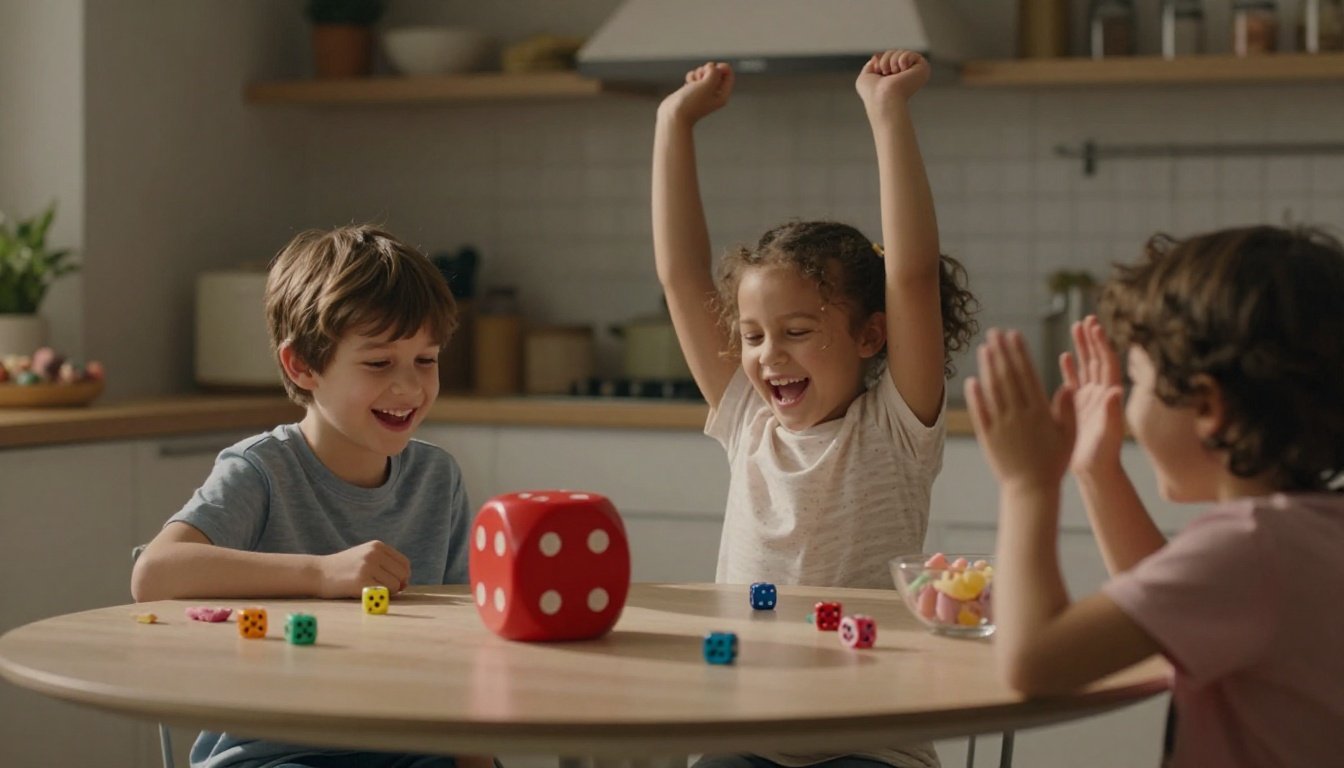
The table erupts in giggles as one child rolls a die, another makes a ridiculous dance, and everyone waits to see what happens next. Funny dice games for kids turn an ordinary afternoon into easy entertainment with supplies you probably already have.
Dice games are inexpensive, quick to learn, and simple to adjust for preschoolers, elementary-age children, or a mixed-age group. Along the way, children practice counting, number recognition, turn-taking, and even subitizing, which means recognizing small dot patterns without counting each one. For more screen-free learning activities for kids, these games are an easy place to start.
Below, you’ll find more than 10 low-prep games with clear rules, silly twists, learning benefits, and practical tips for different ages. Use one die for younger players, add a second die for older children, and supervise closely when young children play with small dice because they can be a choking hazard. Grab your dice, gather the kids, and start with the first laugh-filled game.
Why Easy Dice Games Keep Kids Laughing and Learning
Dice games work because they remove the complicated setup from family play. You need a few dice, a clear surface, and children ready to take turns. Within seconds, each roll creates suspense. Will the number be high, low, matching, or completely unexpected?
That small pause keeps kids involved. Everyone gets a fair chance to roll, wait, react, and try again. Some games in this article are competitive, while others are cooperative or wonderfully silly. Funny rules, sound effects, pretend voices, and playful challenges can make a basic roll memorable.
Learning Happens Between the Laughs
Children practice early math skills without sitting through a worksheet. As they roll and respond, they may work on:
- Counting dots, spaces, objects, or movements.
- Recognizing numerals and connecting them to quantities.
- Adding two dice together and comparing which roll is greater.
- Spotting familiar dot patterns without counting every dot.
- Understanding place value when older children combine larger numbers.
- Noticing patterns, sequences, and repeated results.
Recognizing a small quantity at a glance is called subitizing. The IES Teaching Math to Young Children toolkit identifies it as a foundational early math skill. Research also suggests that board games using traditional number dice can support young children’s early numerical understanding through simple, repeated play (research on number dice games).

Social Skills Grow With Every Turn
A child who waits while someone else rolls is practicing patience. Passing the die teaches turn-taking, while cheering for another player’s silly result builds a friendly group spirit. Cooperative games add another layer because children work toward one shared goal instead of focusing only on winning.
You can adjust the challenge as children grow. Start with one die and small numbers for younger players. Later, add a second die, simple addition, place-value challenges, or timed rounds. For more hands-on Montessori preschool activities, use dice alongside counters, blocks, or other objects children can touch and move. The best learning often feels like a joke, a surprise, or one more turn.
Easy Yet Funny Dice Games for Kids to Start With
These easy dice games for kids need little preparation, yet they keep hands busy and laughter close. Use one die for younger children, then add more dice, larger numbers, or playful rules as their confidence grows.

Tenzi Makes Matching Numbers Feel Like a Mini Race
Give each player the same number of dice, such as five or ten. Everyone rolls at once, then chooses one number to chase. Players keep rolling the dice that don’t match until every die shows the same number.
Tenzi feels fast and exciting, so several short rounds work better than one long game. With five dice, younger children can focus on matching and counting. Older children may enjoy ten dice because the race takes longer and creates more suspense.
Add a silly rule to make each round funnier. Players might name their matching number in a monster voice, make an animal noise, or freeze like a statue when they finish. For a calmer version, let children take turns rolling only their unmatched dice. This reduces the rush while keeping the matching challenge.
Keep the goal playful. A child who doesn’t finish first can still celebrate a clever roll or a funny voice.
Roll and Cover Turns Counting Into a Silly Treasure Hunt
Make a homemade number mat with spaces labeled one through six. Children can cover each space with counters, buttons, blocks, or large paper shapes. A player rolls one die, says the number aloud, and covers the matching space.
When a number is already covered, pass the die to the next player. You can also ask the child to perform a funny action, such as wiggling like a worm or giving a dramatic bow. Older children can roll two dice and cover the total. For an added challenge, let them subtract the smaller number from the larger one.
Choose large pieces that don’t fit in a young child’s mouth, and supervise preschoolers closely. The U.S. Consumer Product Safety Commission’s toy guidance advises keeping toys with small parts away from children younger than 3.
Biggest Number Builds Place-Value Skills Without a Worksheet
Each player rolls two to six dice and arranges the digits into the largest number possible. For example, rolls of 5 and 6 become 65. Rolls of 6, 2, 4, and 5 become 6,542 when arranged from greatest to least.
Players compare their numbers, and the largest one earns a point. Add a game-show host voice for every reveal: “Welcome to the spectacular 6,542!” The losing number might receive a ridiculous name, such as “the sleepy potato number.”
Younger children can compare one-digit results or arrange two dice. Older children can discuss tens, hundreds, and thousands, then explain why placing a larger digit first changes the total. These hands-on number games fit well beside other math and science activities for ages 5 to 7.
Sequence Chase Turns Number Runs Into a Victory Celebration
Give each child one to three dice and ask them to look for a run, such as 1-2-3. You can award five points whenever a player completes a sequence, or let children build one over several turns by saving useful numbers.
Number cards or a strip of paper can show the order for children who need a visual guide. Younger players should focus on recognizing the pattern rather than racing. Older children can search for longer runs or decide which number they need next.
Every completed sequence deserves a tiny celebration. Children might crawl like caterpillars, perform a victory dance, or shout the numbers in a robot voice. The laughter makes the order easier to remember, while the game gives pattern recognition a cheerful place at the table.
More Funny Family Dice Games for Kids and Older Players
When children understand the basic rules, add games with more choices, storytelling, and friendly competition. These funny family dice games work well at the kitchen table, during travel, or alongside other fun family games to play indoors.

Pig and Farkle Let Kids Choose Between Safe and Silly
Pig is a simple push-your-luck game with one die. On each turn, a player rolls repeatedly and adds every number to a temporary score. Rolling a 1 wipes out those turn points, so the player must decide whether to stop and bank the score or risk another roll.
Add a silly consequence when someone rolls a 1. The player might make a pig sound, wiggle their nose, or say, “Oink, I should have stopped!” Then pass the die to the next player. A short target, such as 30 or 50 points, keeps the game moving.
Farkle suits older elementary children because its scoring takes longer to learn. Use five or six dice, then award points for matching numbers and simple combinations. For example, a single 1 or 5 can score, while three matching numbers earn more. A player who rolls no scoring dice loses the points from that turn.
Write a small scoring guide before playing. For a shorter family version, choose a target of 500 points instead of 10,000. Both games teach risk, decision-making, and emotional control, especially when a child must accept that a tempting roll can erase earlier points. For additional dice-game rule variations, these free dice game instructions offer useful ideas.
Ship, Captain, and Crew Brings Pirate Drama to the Table
Ship, Captain, and Crew gives every turn a tiny pirate adventure. Each player rolls three dice, trying to find a 6 for the ship, a 5 for the captain, and a 4 for the crew, in that order. Players can roll up to three times, setting aside each target number after finding it.
Once the ship, captain, and crew are ready, the remaining die becomes the cargo score. The highest cargo wins the round. If a player misses one of the target numbers, their ship never leaves port.
Younger children can use a simpler version. Give them three dice and ask only for the target numbers, without scoring the cargo. Players can use pirate voices, steer through an imaginary storm, or make waves with their hands. The game works best with three dice per player because the rules stay clear and each roll feels important.
Dice Battle Makes Addition Practice Feel Like a Friendly Showdown
Give each player two dice. Everyone rolls, adds the dots, and awards one point or token to the higher total. For a very simple version, each player rolls one die and compares the numbers.
Ties need a clear rule before the game begins. Players can roll again, or both children can receive a point. Either choice keeps the result fair and prevents an argument over who deserves the token.
Older children can roll three dice, subtract the lowest number, multiply two dice, or try to reach a target number. Give the winner a playful title, such as Sum Champion, Tiny Math Wizard, or Grand Duke of Seven. Keep the focus on comparing numbers and enjoying each round, not winning every time.
Bunco and Sevens Turn Dice Into Team Storytelling
For a shortened Bunco game, choose a target number for each round. Players roll several dice and earn one point for every die that matches the target. Change the target after each round, then play three quick rounds with fewer dice. Full Bunco often uses teams, multiple tables, and many rounds, but families can keep the same idea without a large group.
Sevens can become a run-building game for younger players. Children collect or search for sequences such as 1-2 or 1-2-3, saving useful numbers across turns. Each completed run earns a point, a token, or a group cheer.
Add a story to every sequence. A 1-2 run might become a two-legged creature, while 1-2-3 could be a secret code for a pretend treasure map. Cooperative scoring works well here because everyone can help build the family total. If you want another take on Sevens, these simple dice game rules describe a different beginner-friendly version.
How to Choose the Right Dice Game for Your Kids
The best dice game matches your child’s age, attention span, energy level, and comfort with competition. A quick matching game may delight a preschooler, while an older child may enjoy making decisions in Farkle. Start with the simplest version, then adjust the rules as your children gain confidence.
Pick Games by Age, Attention Span, and Energy Level
For ages 3 to 5, matching and roll-and-cover games are usually the easiest place to begin. An adult can read the numbers, count dots, explain each turn, and help children wait for the die. Use a visual number mat so children can connect the number they roll with a matching space. Short rounds also keep the game from feeling like work.
Elementary-age children can usually handle more choices and simple scoring. Biggest Number, Dice Battle, Ship, Captain, and Crew, Sevens, and short versions of Pig offer enough structure without taking too long. For example, set a small target for Pig, such as 30 points, instead of playing until someone reaches a much higher score.
Reserve Farkle and longer Bunco-style games for children who can follow multi-step rules and remember changing goals. You can still include younger siblings by giving them one simple job, such as rolling, counting matching dice, or handing out counters.
Match the game to the mood in the room:
- Choose Tenzi when children have energy for a fast matching race.
- Use Pig when older children want choices but the group needs a slower pace.
- Pick Roll and Cover when everyone needs a calm, hands-on activity.
- Try team play when different ages or skill levels make individual scoring frustrating.
Use Simple Supplies and Flexible House Rules
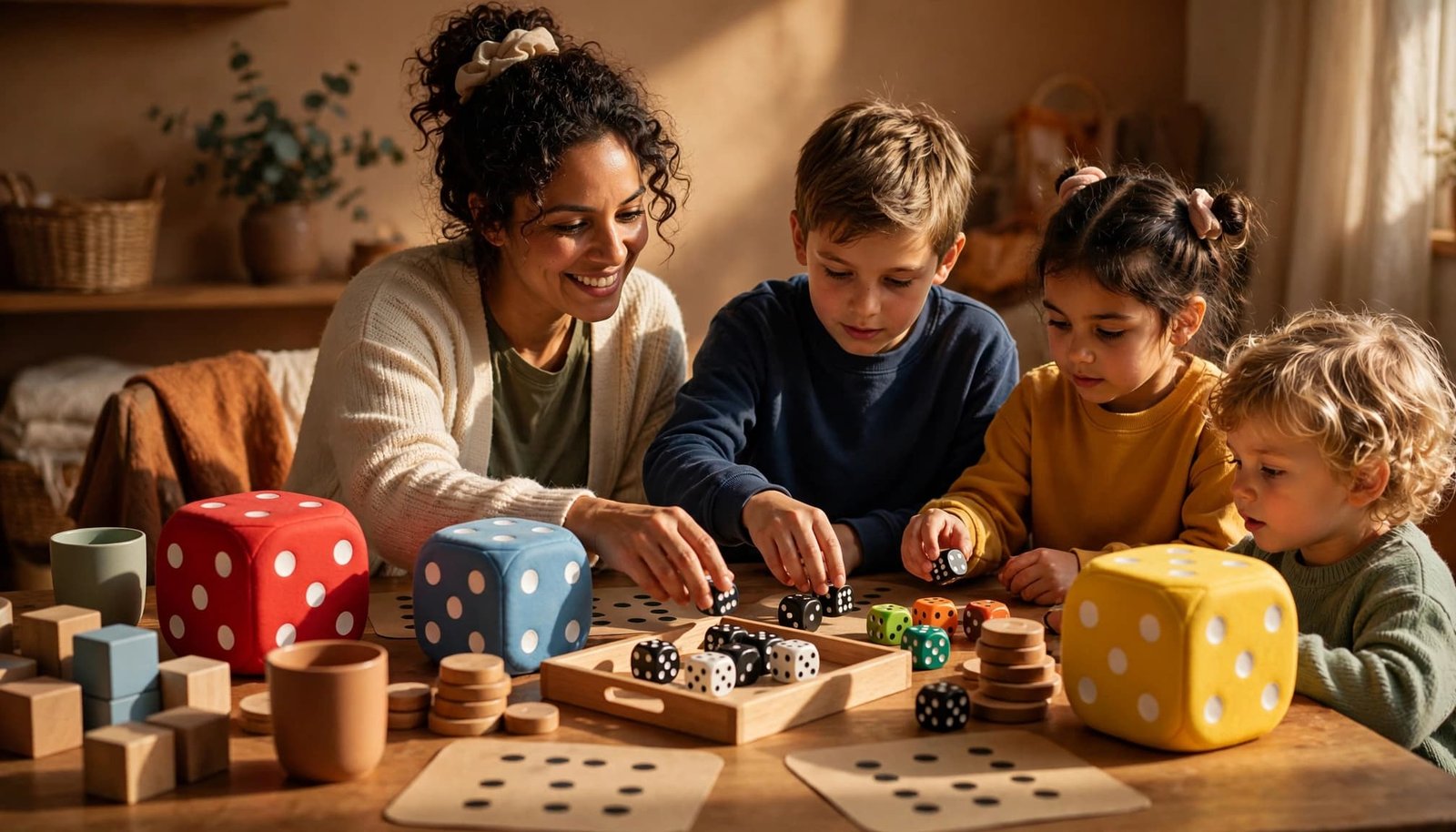
You need only a few ordinary supplies: dice, paper, pencils, counters, blocks, cups, and a shallow tray. The tray keeps dice from rolling under furniture, while paper mats make abstract numbers easier to see. Counters and blocks also give children something to touch, move, stack, or cover.
A few flexible rules can protect the fun:
- Play for a set number of rounds instead of waiting for a high score.
- Allow a restart when a turn becomes confusing.
- Pair younger children with an older sibling or adult.
- Give points for good sportsmanship, helpfulness, or creative sound effects.
Changing a rule is fine if it keeps children engaged. You might let everyone share a win, remove a time limit, or replace written scoring with a pile of blocks. For more quiet learning activities for young children, use the same dice with color cards, nesting cups, or household objects.
Make Dice Play Comfortable and Inclusive for Everyone
Children with low vision may benefit from large, high-contrast foam dice with clear pips or numerals. Math adaptations for children with visual impairments often make number information easier to see or feel, so consider accessible math activity ideas when choosing materials.
For fine-motor challenges, offer easy-grip dice, a rolling cup, fewer dice, and extra time. A child can point to a number, choose a counter, stack blocks, or cover a space instead of writing. Visual turn cards can show who rolls next, especially when several children play together.
Sensory needs matter, too. Soft foam dice reduce noise and impact, while a tray creates a defined rolling space. If competition causes stress, set a cooperative goal, such as filling a number board together. Older siblings can become scorekeepers, helpers, or teammates, but let the younger child control their own choices.
Small dice and loose accessories can be choking hazards for young children. The U.S. Consumer Product Safety Commission advises keeping small parts away from children under 3, so supervise closely and choose large, durable materials that don’t shed pieces.
Conclusion
A handful of dice can create a whole afternoon of giggles, math practice, storytelling, and connection. Choose Roll and Cover or a simple matching game for preschool learning, Tenzi for quick play, Pig or Farkle for competitive older kids, and Bunco or team Sevens for a larger group. These games also pair well with other play-based learning ideas for kids.
Start with one game and add a silly house rule, such as a funny voice, victory dance, or animal sound. Then let the children invent new versions as they become comfortable with the rules. Keep small dice away from children under 3 because they can create a choking hazard. Most importantly, the laughter and shared time matter more than keeping a perfect score.
Save pin for later


- Dry Cough in Kids: 5 Causes and Safe Solutions - September 23, 2026
- How to Help a Child Deal With Anxiety at Home - September 12, 2026
- How to Prepare Your Child for the First Day of School - September 12, 2026