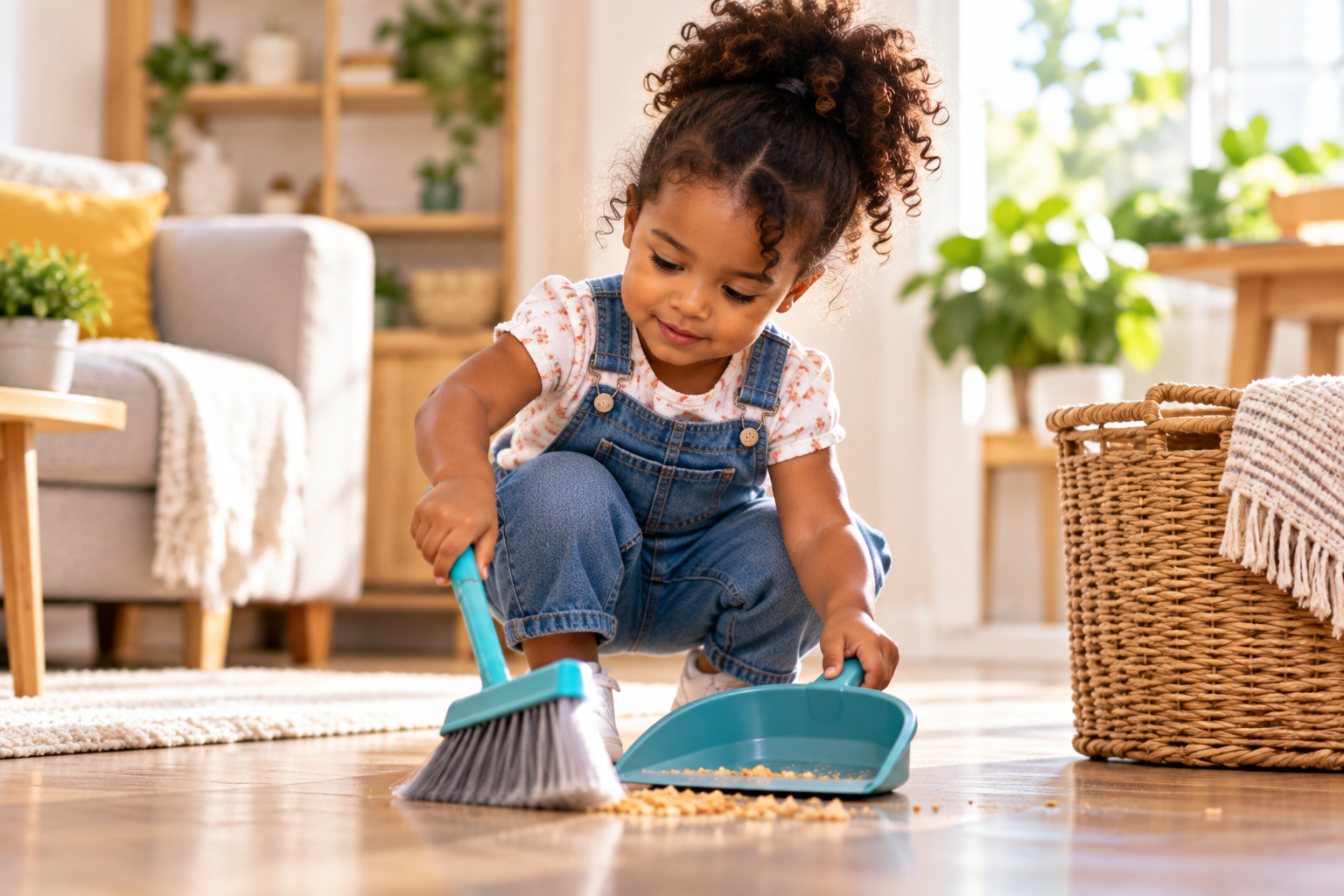
Your 5-year-old wants to set the table, but half of you worries the plates are headed for the floor. Or maybe you’re wondering if your teenager should be doing their own laundry by now. Both questions have real answers, and they’re probably simpler than you think.
Giving kids age-appropriate chores builds responsibility, confidence, and everyday life skills without overwhelming them. The trick is matching the task to what your child can actually handle at their stage, then letting go a little.
In this post, you’ll find chore ideas for every age group, from toddlers through teens, plus practical tips for making chores stick once the novelty wears off.
Why Age-Appropriate Chores for Kids Actually Matter
Chores often get treated as a bargaining chip or a punishment, but research tells a different story. Kids who regularly help around the house tend to grow into more capable, confident adults, and the benefits start showing up long before adulthood.
The key phrase here is age-appropriate. A chore that matches your child’s abilities builds them up, while one that’s too hard sets everyone up for tears and standoffs.
The Research Behind Chores and Success
The Harvard Grant Study, one of the longest-running studies of adult development, followed men for over 75 years and found that children who did chores grew into more successful, well-adjusted adults. Chores ranked among the strongest predictors of professional success, ahead of intelligence and family background.
Why? Because washing dishes at age seven teaches something a trophy never can: your contribution matters. There’s a well-documented connection between childhood chores and later self-reliance, a stronger work ethic, and genuine feelings of being a valued family member.
Matching Tasks to Ability Prevents Power Struggles
Handing a 4-year-old a squeegee and expecting streak-free windows is a recipe for frustration on both sides. When the task fits the child, they succeed, feel proud, and want to do more.
Get the match wrong and you’ll face constant negotiations, half-finished jobs, and resentment. The fix is simple: pick chores that challenge without overwhelming, and expect age-appropriate results (a toddler’s “made” bed will look like a lump, and that’s fine). If you’re building a routine around this, pairing chores with consistent daily habits for kids makes the whole system easier to maintain.
Age-Appropriate Chores For Kids: A Breakdown By Age Group
Every kid develops at a different pace, so treat these as flexible guidelines rather than hard rules. A cautious 7-year-old might still be mastering what a bold 5-year-old already handles, and that’s normal. The lists below give you a starting point. Adjust up or down based on your child’s maturity, coordination, and interest. And if you’re wondering whether it’s too early to start, it isn’t: toddlers can pitch in as young as age 2 with simple tasks.
Toddlers (Ages 2 to 4): Little Helpers With Big Pride
Toddlers love copying grown-ups, so this stage is about participation, not results. Good starter chores include:
- Putting toys in a bin
- Dropping dirty clothes in the hamper
- Helping fill the pet’s food bowl
- Wiping up spills with a small cloth
- “Making” the bed with your help
- Carrying their own plate to the sink
Yes, the bed will look like a lump. The folded washcloth will be a ball. That’s fine. At this age, praise matters more than performance. A toddler who feels like a helpful family member keeps wanting to help, and that motivation is worth protecting.
Preschool and Kindergarten (Ages 4 to 6): Chores With Real Results
Kids this age can finish tasks that actually look done. Their coordination is improving, even if their attention spans run short. Try:
- Making their bed independently (it’ll be lumpy, let it be)
- Setting the table with placemats as guides
- Watering plants with a small can
- Sorting laundry into lights and darks
- Dusting surfaces they can reach
- Washing fruits and veggies for dinner
A visual chore chart works wonders here, because pictures beat words for pre-readers. Keep instructions to one or two steps, and expect to remind them. Consistency at this stage builds the habit you’ll rely on later.
Early Elementary (Ages 6 to 9): Building Real Skills
Now your child can handle multi-step tasks and start owning a job from start to finish. Solid options include:
- Sweeping the kitchen or porch
- Loading and unloading the dishwasher
- Carrying small trash bins to the curb
- Packing their own school bag
- Folding towels and matching socks
- Assembling sandwiches or simple snacks
This is the sweet spot for building competence. Kids feel the difference between being “helped” and doing it themselves, and it matters to them. Resist the urge to redo their work in front of them; a quietly straightened towel is fine, a takeover isn’t.
Tweens (Ages 10 to 12): Handling More Independence
Tweens can run a full task without supervision on most days. Consider assigning:
- Doing their own laundry, wash to fold
- Washing dishes by hand
- Yard help, like raking or mowing with supervision
- Cleaning bathrooms
- Cooking simple meals with you nearby
- Short babysitting stretches for younger siblings
- Walking the dog
It’s also a great age to introduce money lessons tied to chores, whether that’s an allowance, a commission per job, or savings goals. Money conversations land better when they’re attached to real effort.
Teens (Ages 13 to 17): Preparing for Real Life
Teen chores should look a lot like adult skills, because that’s what’s coming. Aim for:
- Planning and cooking a full meal once a week
- Writing a grocery list and shopping solo
- Deep cleaning their room and shared spaces
- Car basics, like washing it and checking fluids
- Managing their own laundry and schedule without reminders
- Small repairs, from a loose screw to a running toilet
The goal shifts from helping the household to preparing for independence. A teen who can cook, clean, and manage their time will handle the transition after high school far better than one who can’t.
Should Kids Get Allowance for Chores? How to Handle Rewards
Sooner or later, your kid asks the big question: do I get paid for this? There’s no single right answer, but there are two main camps, and each comes with tradeoffs worth understanding before you decide.
Chores as Family Contributions
In this camp, chores are unpaid because everyone pitches in. The family is a team, and cleaning up is part of belonging to it, like a membership dues situation but with more laundry.
Pros: Kids learn that some work carries no reward beyond a functioning household. It builds intrinsic motivation, which research on the “overjustification effect” suggests can actually shrink when you attach payment to tasks kids already enjoy.
Cons: Without any reward, motivation can fizzle around age 8 or so, when the “helping feels fun” phase wears off. Some kids also struggle to connect effort with anything tangible.
Paid Chores and Allowance Systems
The other camp ties money directly to work. You pay a base allowance unconditionally, then offer extra paid jobs above the household baseline, like washing the car or organizing the garage. That structure keeps family contributions intact while teaching that extra effort earns extra money.
Average allowances in 2026 dollars run roughly $1 to $2 per year of age weekly, so a 10-year-old might earn around $10 to $15 a week, depending on your region and what the money covers. Apps like Greenlight and GoHenry automate the whole thing, linking completed chores to payments and adding debit cards plus savings and spending tools for kids.
Pros: Real money creates real lessons in saving, spending, and budgeting, and the paid-extra model avoids paying for basic participation.
Cons: Kids can start asking “how much?” before volunteering, and payments can stall once the novelty fades if you’re not consistent.
A Practical Middle Ground
Most families do best with a hybrid. Set a handful of non-negotiable chores nobody gets paid for, then keep a short list of extra jobs with set prices. Pay reliably and on time, and let kids manage their earnings with light guidance. That way they learn both lessons: families run on unpaid contribution, and the market pays for work that goes beyond it.
How to Get Kids to Actually Do Their Chores (Without Nagging)
Knowing which chores fit which ages is half the battle. The other half is getting your child to do them day after day without you sounding like a broken record. A few simple systems take the pressure off your voice and put it on the routine itself, so the chart becomes the authority instead of you.
Set Up a Chore Chart or System That Works
Pick a system your family will actually look at, because a chart nobody sees is a chart nobody uses. Printable charts taped to the fridge work well for younger kids, especially with pictures instead of words. Magnetic boards let kids move a marker from “to do” to “done,” which gives them a small hit of accomplishment every time.
For older kids who carry their own devices, apps like OurHome and FamilyWall assign chores, send reminders, and track points automatically. A rotating chore wheel is another low-tech favorite, since it spreads the unpopular jobs fairly and ends the “why do I always get this?” debates. Whatever you choose, keep it visible and update it the same way every week. Consistency beats cleverness here.
Teach First, Then Step Back
Nobody was born knowing how to sort laundry. Expecting a child to nail a chore they’ve watched you do once is unfair to both of you, so use a gradual release instead. First, do the task together while you talk through each step. Next, let them run the show while you supervise and answer questions. Finally, hand it over completely and let them own it.
Resist redoing their work while they watch. Nothing shuts down a motivated kid faster than straightening the towels they just folded. If the job needs fixing, wait until later or teach the fix as a friendly pointer. Their version of “clean” improves with practice, but only if they keep practicing.
Praise Effort and Keep Expectations Realistic
Specific praise lands better than a generic “good job.” Saying “you remembered to sort the colors and whites without me asking” tells your child exactly what they did well, and they’ll repeat it. Natural consequences work too: a chore skipped means screen time waits or the allowance for extra jobs shrinks, applied calmly rather than angrily.
Above all, drop the perfectionism. A 6-year-old’s swept floor will have crumbs near the edges, and that’s a win, not a failure. A lumpy bed and a wobbly place setting still count. What shapes the habit is consistency, not enthusiasm. Kids who do chores imperfectly every day learn far more than kids who do them perfectly once a month.
Common Chore Mistakes Parents Make (And How to Avoid Them)
Even well-meaning parents fall into a few predictable traps with chores. The good news is that every one of them has a simple fix.
- Assigning chores that are too advanced. A task beyond your child’s abilities ends in tears or a half-done job, and you end up redoing it anyway. Scale the task down until they can finish it with a little coaching.
- Doing everything yourself because it’s faster. Sure, you can load the dishwasher in three minutes flat, but every time you take over, your child learns someone else will handle it. Accept the slower pace now for a capable kid later.
- Inconsistent follow-through. If chores happen only when you remember, kids learn that waiting long enough gets them off the hook. Pick a routine and hold it the same way every day, even when it’s inconvenient.
- Using chores only as punishment. When scrubbing the toilet becomes a consequence for bad behavior, kids associate helping with being in trouble. Keep chores neutral and frame them as part of family life instead.
- Comparing siblings. Saying “your sister did hers without being asked” breeds resentment rather than motivation. Track each child against their own progress, not against each other.
One shift makes all of these easier: treat chores as a skill your child builds over time rather than a favor they owe you. Patience with the messy early attempts pays off.
Conclusion
Chores are one of the simplest, most reliable ways to raise capable, confident kids, and the right chore at the right age makes all the difference. A toddler who carries plates, a tween who does laundry, a teen who cooks dinner: each one is building skills that will stick for life.
Start small this week. Pick two or three chores from the age lists above, show your child how it’s done, then step back and let them own it. Pair the new jobs with a chart or routine so they happen without you having to ask.
Progress beats perfection every time. The lumpy bed and the crumbs by the baseboard count. Every imperfect, repeated attempt is teaching your child that they’re a real contributor to your family, and that lesson is worth more than a spotless house ever will be.
Save pin for later


- Signs Your Baby Is Ready For Solid Foods - September 23, 2026
- First Trimester Survival Guide For Working Moms - September 23, 2026
- White Noise For Babies: Does It Really Help? - September 23, 2026