
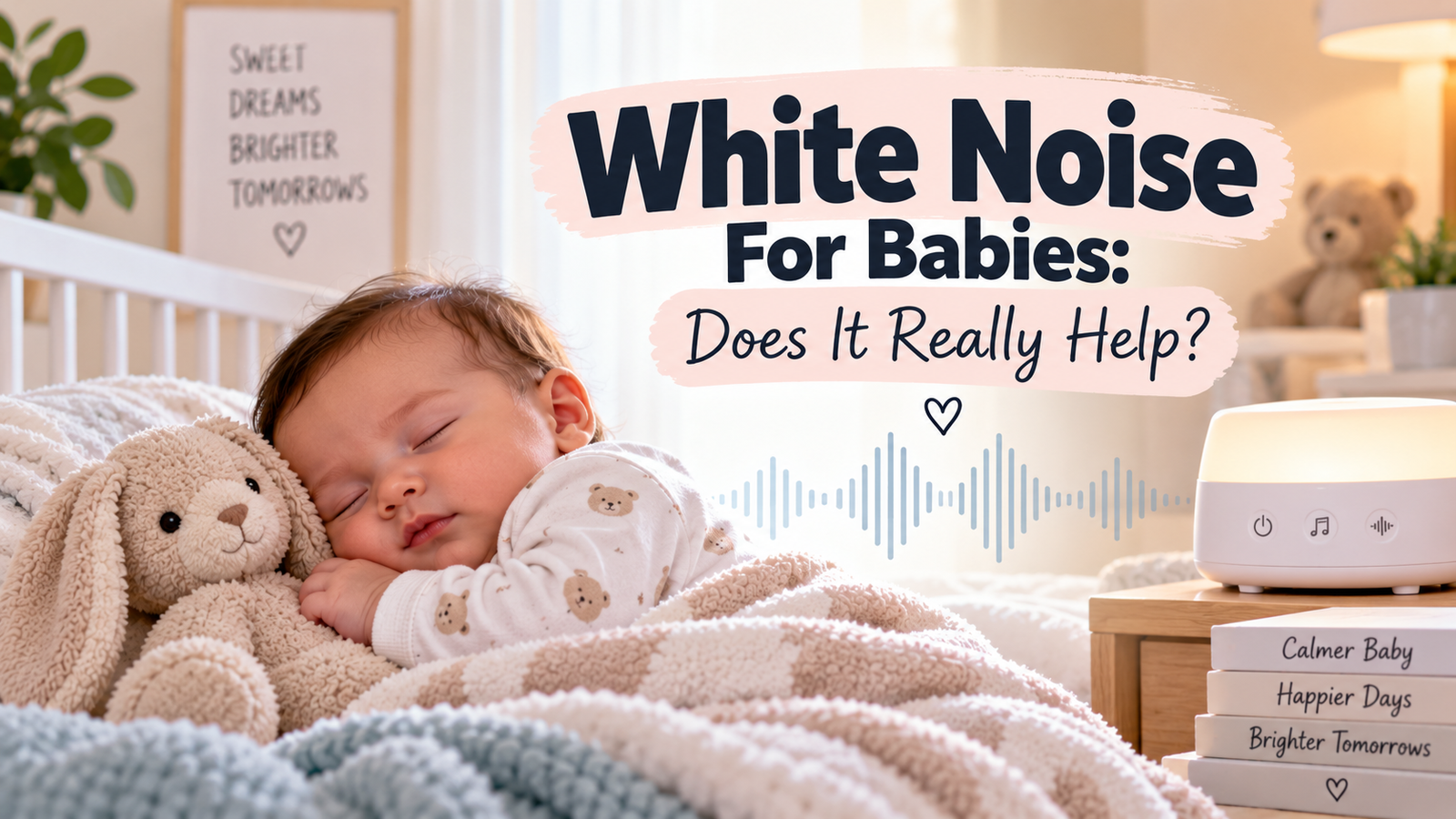
It’s 2 a.m. and you’re standing over the crib, one hand on the sound machine dial, wondering if any of this is actually working. If you’ve ever questioned whether that steady shhh is helping your baby sleep or just draining your electricity, you’re not alone.
White noise machines sit in millions of nurseries, and pediatricians often recommend them. But they come with real questions about volume, placement, and long-term effects that most parents never hear about.
Yes, white noise can genuinely help babies fall asleep, and the research backs that up. But how you use it matters more than whether you use it. Let’s look at what white noise actually is, what studies show, and how to make it work safely in your nursery.
What Is White Noise, and Why Do Babies Respond to It?
White noise is a steady, even sound that blends all the frequencies humans can hear into one consistent hum. Think of the static between radio stations or a fan running on a summer night. Instead of silence punctuated by creaks, barking dogs, or a sibling’s slam of a door, your baby hears one unchanging blanket of sound. That consistency is the whole trick. Sudden noises startle sleeping babies awake, but a steady background sound masks those interruptions before they ever register.
White Noise vs. Pink Noise vs. Brown Noise
These three sound types sit on a family tree, and the difference comes down to which frequencies get more weight.
- White noise spreads energy evenly across all frequencies. It sounds bright and hissy, like radio static or a strong fan.
- Pink noise dials down the higher frequencies a bit, so it sounds softer and more balanced, like steady rainfall or leaves rustling.
- Brown noise pushes even more energy into the low end, producing a deep rumble like thunder, a distant waterfall, or a rough airplane cabin.
Most sound machines and baby monitor apps offer all three, and parents often find pink and brown noise gentler on adult ears during those 3 a.m. feeds. In practice, the specific color you pick matters far less than two things: keeping the volume at a safe level (around 50 decibels, or roughly the sound of a quiet shower) and placing the machine at least seven feet from the crib. A brown noise machine played too loud and too close does more harm than white noise used correctly.
The Womb Connection: Why Steady Sound Feels Comforting
Newborns don’t experience silence as peaceful. They’ve never known it. For nine months, your baby lived inside a constant wall of sound: your heartbeat, blood flow, digestion, and muffled voices. Measurements of the intrauterine environment put that noise around 80 to 85 decibels, roughly as loud as a vacuum cleaner running in the room. Silence, to a newborn, is actually the strange new experience.
This is why pediatrician Harvey Karp popularized the idea of the “fourth trimester,” the first three months of life when babies still crave womb-like conditions. A shushing sound or steady hum mimics that familiar environment and can calm a crying infant within minutes, an effect Karp documented in his book The Happiest Baby on the Block.
So when your baby settles faster under white noise, it isn’t a mystery or a coincidence. You’re reproducing the sound world they spent nine months inside. The steady hum tells their nervous system that everything is as it should be, which makes drifting off to sleep much easier.
Does White Noise Really Help Babies Sleep?
The short answer is yes, for many babies, but with honest limits. Research going back decades shows that steady background sound can shorten the time it takes infants to fall asleep. A frequently cited study from the early 1990s found that newborns exposed to white noise fell asleep noticeably faster than babies left in quiet rooms, with a large share settling within minutes. More recent studies on infant settling point in the same direction: babies in noisy households often wake less when a consistent sound masks sudden interruptions.
That said, the evidence is far from unanimous. Some trials show modest improvements, others show little difference between babies who use white noise and those who don’t. Results vary widely by temperament, age, and how overtired the baby already is. Treat white noise as a helpful tool, not a guaranteed switch you flip to produce sleep.
What White Noise Can and Can’t Do
White noise earns its place in the nursery for a few concrete reasons:
- It masks household noise. Door slams, siblings, and the dog barking stop jolting your baby awake mid-nap.
- It keeps naps consistent. A predictable sound environment helps babies settle faster in different rooms or during travel.
- It becomes a sleep cue. Over time, the hum signals that sleep is coming, the same way a darkened room does.
Now the honest part. White noise won’t fix an overtired baby who has passed the point of easy settling. It won’t resolve hunger, a wet diaper, or the havoc of a sleep regression, and it can’t override a wake window that ran too long. If your baby fights sleep because of timing or a developmental leap, the machine isn’t the problem or the solution. It supports good sleep habits; it doesn’t replace them.
Can Babies Become Dependent on White Noise?
This is the worry that keeps parents up at night, sometimes literally. Sleep associations are real, and sound is one of them. A baby who always falls asleep to white noise may wake between sleep cycles and look for it.
Here’s the reassuring part: white noise is one of the gentlest sleep associations out there. Unlike rocking or feeding to sleep, it requires nothing from you at 3 a.m. Many families simply keep it through toddlerhood without issue. If you do want to phase it out, taper gradually. Lower the volume a notch every few nights over a week or two, then move the machine farther from the crib. Most babies adapt without a fight, especially if you keep the rest of the bedtime routine unchanged.
The key is choice. Use white noise deliberately, knowing you can dial it back later, rather than feeling trapped by it.
Is White Noise Safe for Babies? What Experts Say
For the most part, yes. Pediatricians, including the American Academy of Pediatrics (AAP), consider white noise a safe sleep aid when it’s used correctly. The keyword there is “correctly.” The two factors that determine safety are volume and distance, and both are easier to control than most parents realize. Babies’ ears are more sensitive than adult ears, and infants spend far more time asleep, which means their developing auditory systems get extended exposure to whatever sound you play. That makes the details worth getting right.
There’s one study that shaped most of the current guidance. In 2014, researchers published a study in Pediatrics testing 14 popular white noise machines designed for infants. Several of them, when set to maximum volume and placed close to a crib, produced sound levels above the recommended limits for hospital nurseries. Some approached levels associated with hearing damage under the occupational noise standards the researchers used as a benchmark. The machines weren’t inherently dangerous; they were simply capable of being too loud in the wrong setup. The study’s authors recommended lower volumes, greater distances, and built-in timers on infant sound machines, and manufacturers have since taken note.
The AAP’s current guidance echoes those findings. Keep the machine at least 7 feet (about 2 meters) from the crib and keep the volume at or below 50 decibels, roughly the level of a quiet conversation or soft shower. Some researchers have also raised a theoretical concern about auditory development: constant background sound at high levels might interfere with how babies learn to process speech and varied sounds during waking hours. The evidence there is thin and largely based on animal studies, but it’s another reason loud, all-day noise isn’t a good idea.
Here’s the reassuring part: none of this means white noise is risky for your baby when handled sensibly. It means treating the machine like a tool with settings, not a plug-and-forget appliance. The practical rules below take care of nearly every concern the research raises.
Safe Volume Levels and Machine Placement
A few simple habits make white noise consistently safe:
- Aim for around 50 decibels at the crib, not at the machine. Download a free decibel meter app and measure where your baby’s head rests while they sleep.
- Place the machine across the room, at least 7 feet away. If your nursery is small, put it on a shelf as far from the crib as the room allows.
- Never put the machine in the crib, on the crib rail, or clipped to the bassinet. Close-range sound is what got some machines in trouble during testing.
- Use the lowest effective volume. If it masks household noise without blasting, that’s enough.
- Consider a timer or turning it off once your baby is in deep sleep for naps, though all-night use at safe levels is generally fine.
Check the setup once and re-check after moving furniture. Volume drops off quickly with distance, so small changes in placement make a real difference.
When to Skip White Noise Entirely
White noise isn’t the right call in every situation. Hold off or talk to your pediatrician first if any of the following apply:
- Your baby has a diagnosed hearing condition or a family history of hearing loss, since management of sound exposure should follow professional guidance.
- Your baby seems startled or distressed by the sound rather than calmed by it. Some infants simply don’t like it, and that’s a valid answer.
- You’re running it loud and constant through every waking hour, which circles back to the speech-processing question researchers have raised.
- Sleep problems have a clear cause the machine can’t touch, like reflux, an illness, or a schedule that’s badly out of sync.
If your baby fights sleep despite good timing, a solid routine, and a healthy checkup, the answer probably isn’t a louder sound machine. A pediatrician can help identify what’s actually going on before you stack another tool on top of a problem that needs a different fix.
How to Use White Noise for Babies the Right Way
Everything so far comes down to execution. The difference between white noise that helps and white noise that adds risk is a handful of small decisions: which machine you buy, where it sits, and when it plays. The good news is that the whole setup takes one evening to get right. Here’s how to build it into a system you can follow tonight, starting with the gear itself.
Choosing a Sound Machine: Features That Actually Matter
You don’t need a $100 gadget. Plenty of $20 machines do the job well, and a box fan or a phone app works too if money is tight. What matters is how the machine performs in a few specific areas:
- Continuous play. Some machines shut off after 30 or 60 minutes, right when your baby cycles into lighter sleep. Pick one that runs all night, or plan to restart it yourself.
- Fine volume control. You want small increments, ideally one decibel at a time. Machines with three loud settings make it hard to land near 50 decibels at the crib.
- Natural or non-looping sounds. Cheap machines loop a short recording, and the gap between loops can wake a light sleeper. Real fan sounds or long, seamless recordings avoid that problem.
- A timer, if you want flexibility. Most safety guidance favors all-night play at safe volumes, but a timer gives you options for naps.
If you already own something that hums steadily, try it before buying anything. A fan costs nothing, masks noise, and doubles as airflow in the room.
A Simple Bedtime Routine with White Noise
Once you have the setup, the routine is almost boring, which is exactly what you want. Babies thrive on predictability, and the sound becomes part of the sequence that tells them sleep is coming.
- Start the machine first. Turn it on before the feed, the pajamas, or the lullaby. The sound becomes the opening cue, the same way dimming the lights does.
- Keep every step in the same order. Feed, bath if it’s a bath night, pajamas, dark room, into the crib. White noise layered on top of a consistent routine works better than white noise alone.
- Leave it on all night. Turning it off after your baby falls asleep removes the masking benefit during the early-morning hours, when sleep is lightest.
- Keep it running through night feeds. This one saves many parents. If the sound stays on, your baby stirs, feeds, and drifts back down. If you switch on bright lights and silence, 2 a.m. starts to look like playtime.
That’s the whole system. Set the volume near 50 decibels, place the machine across the room, run it from lights-out to morning, and repeat it the same way every night. Within a week or two, most babies treat that steady hum as their signal that sleep is safe and expected.
Common White Noise Mistakes Parents Make
Even a great tool fails when it’s used badly. Most white noise problems trace back to five easy-to-fix habits, so a quick self-audit of your setup is worth two minutes of your time.
- Playing it too loud. Anything above 50 decibels at the crib puts your baby’s developing ears under more strain than necessary, and louder doesn’t mean sleepier. Louder just means louder.
- Placing the machine too close. A device on the crib rail or bassinet edge can exceed safe limits even at modest volume settings. Distance is your cheapest safety feature, so push it across the room.
- Using tracks with loops or sudden changes. A short recording that gaps or shifts can wake a light sleeper at the worst moment. Pick long, seamless sounds or steady fan noise instead.
- Switching it off the second your baby falls asleep. This one backfires. Babies cycle into lighter sleep every 40 to 60 minutes, and the early-morning hours are the lightest of all. Without the masking sound, a hallway creak ends the nap. Leave it running.
- Treating it as a cure-all. White noise supports good sleep; it doesn’t rescue a schedule in chaos. An overtired baby fighting every nap needs better-timed wake windows, not more volume.
That last point deserves the most attention. If the machine runs all night and your baby still wakes constantly, look at timing first. Our guide to baby sleep schedules on momwithvib.com walks through age-appropriate wake windows that make the white noise actually work.
Fix these five and you’ll get the benefit the research promises, without the risks.
Conclusion
So, does white noise really help babies? Yes, for many babies it does. It shortens the time it takes them to settle, masks the household sounds that break light sleep, and becomes a reliable cue that bedtime has arrived. The research supports it, and pediatric guidance supports it too, as long as you keep the volume near 50 decibels, place the machine at least seven feet from the crib, and let it run through the night.
Just remember that your baby is the final judge. Some infants melt into sleep the moment the hum starts; others could not care less. Watch how your little one responds and adjust from there, because you know your baby better than any study does.
A steady shhh and a consistent routine can genuinely change your nights. If you want more help building better sleep habits, browse the rest of our baby sleep tips and keep finding what works for your family. Here’s to quieter nights and better rest for everyone under your roof.
Save pin for later

- Signs Your Baby Is Ready For Solid Foods - September 23, 2026
- First Trimester Survival Guide For Working Moms - September 23, 2026
- White Noise For Babies: Does It Really Help? - September 23, 2026