

One day you’re eating pasta, and your baby is locked onto your fork like it’s the most fascinating thing in the room. Suddenly every meal feels like a test you didn’t study for.
Here’s the short answer: most babies are ready for solids around 6 months, but age alone doesn’t tell the whole story. Some babies show signs of readiness earlier, others a few weeks later, and pushing solids too soon can make feeding harder for both of you.
The good news is your baby will actually tell you when it’s time. They do it through head control, interest in your food, and a handful of other milestones that are easy to spot once you know what to look for.
Below, you’ll find five clear signs your baby is ready, so you can start solids with confidence instead of second-guessing every spoonful.
Signs Your Baby Is Ready For Solid Foods
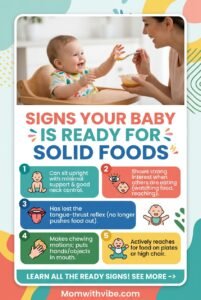
Most babies hit the solids window somewhere between 4 and 6 months, but the calendar is the least useful tool here. What actually matters is whether your baby has developed the physical skills to sit safely, move food around their mouth, and swallow without gagging everything back out. Pediatric organizations like the American Academy of Pediatrics recommend watching for these milestones rather than picking a date.
So before you buy that first jar of puree, check your baby against the five signs below. If they tick most of the boxes, you’re ready. If not, give it a couple more weeks and check again.
Your Baby Can Sit Up With Little or No Support
Sitting sounds boring, but it’s the foundation of safe eating. When your baby sits upright in a high chair with their trunk steady, their airway sits in the right position for swallowing. Slouched or reclined, food can slide back toward the throat before your baby has control over it.
That’s why feeding solids in a bouncer, car seat, or lounger isn’t a good idea. Those seats look cozy, but they tip your baby backward and remove the postural control that swallowing depends on. A quick test: sit your baby on the floor with a hand nearby. If they can stay upright for a minute or two while reaching for a toy, they’re there. If they slump or topple, wait.
The Tongue-Thrust Reflex Has Faded
Babies are born with a built-in safety feature called the tongue-thrust reflex. When anything touches the front of their mouth, their tongue automatically pushes it back out. It protects young infants from choking, and it also means a spoonful of puree goes everywhere except their stomach.
To test it, offer a tiny amount of very soft food on a spoon. A baby who’s ready will move the food back and swallow, even messily. A baby who’s not ready will push it straight back out, over and over. One push doesn’t tell you much; babies are humans, not machines. But if every bite gets ejected, the reflex is still active and solids will frustrate both of you. Give it two or three weeks and try again.
Your Baby Shows Real Interest in Your Food
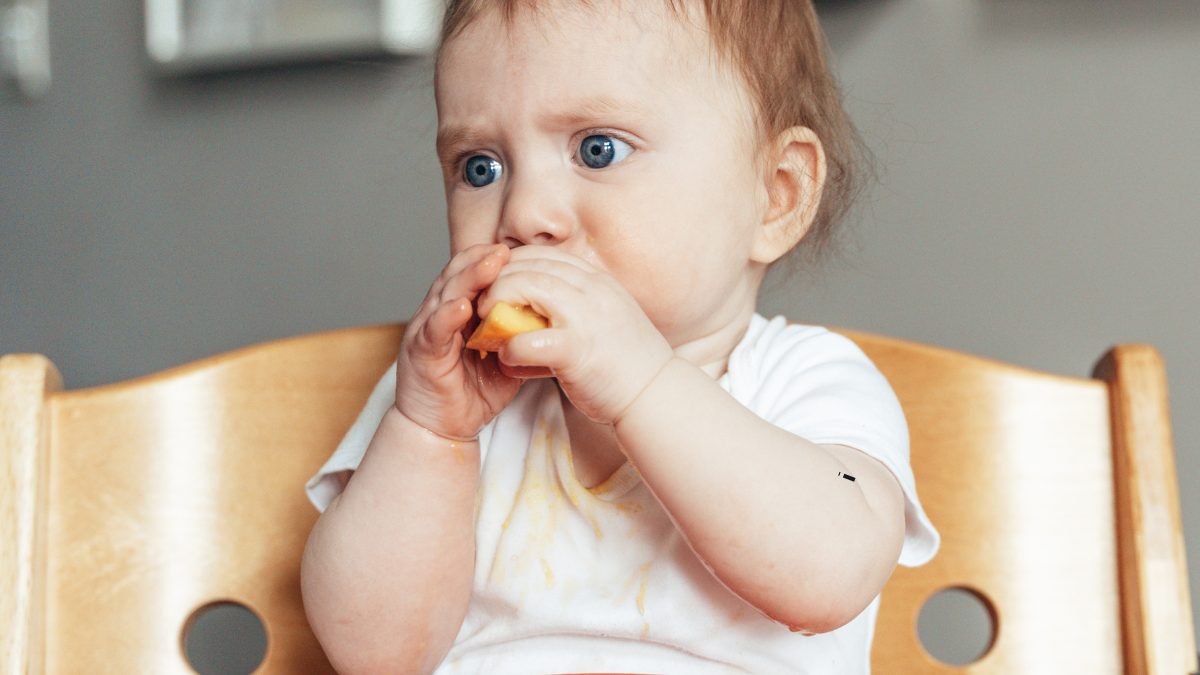
Babies start mouthing everything around 3 to 4 months, so chewing on a toy isn’t a readiness sign by itself. Real interest in food looks different. It’s intense.
Watch for these behaviors at mealtimes:
- Reaching for your plate or spoon, sometimes with impressive determination
- Leaning forward when food comes near
- Opening their mouth as a spoon approaches
- Watching every bite you take, eyes tracking your fork like a tennis match
Teething babies gnaw on things because their gums hurt. A baby who’s developmentally hungry for solids wants your food, at your table, right now. That difference is usually obvious once you know to look for it.
Head and Neck Control Are Solid
This one is non-negotiable. Your baby needs to hold their head up steadily, without wobbling, before any food crosses their lips. Strong neck control keeps the head upright during and after a swallow, which protects the airway.
Try the head-up-and-steady test. Hold your baby upright on your lap and see whether their head bobbles or flops. You can also pull them gently from lying to sitting and watch whether the head lags behind or follows smoothly. Wobbling means more time. Steady means you’re on track. If head control is shaky, everything else on this list matters less, because safe swallowing isn’t possible yet.
Your Baby Can Grab Food and Bring It to Their Mouth
Watch your baby’s hands. When they can pick up an object, transfer it between hands, and land it in their mouth on purpose, they’ve built the coordination that eating requires.
For spoon-feeding, this skill matters less. But if you’re considering baby-led weaning, where babies feed themselves soft finger foods from the start, hand-to-mouth coordination is essential. Your baby needs to grab food, hold it, and get it where it belongs consistently. The palmar grasp (scooping things into a fist with the whole palm) shows up around 5 to 6 months and is perfectly fine for self-feeding. Pick up a soft steamed carrot stick, hold it in your own fist, and imagine that grip around real food. If your baby can already do that with a toy, they can do it with food.
Remember, few babies show all five signs on the same day. Readiness is a cluster, not a checklist with a deadline. If your baby has most of these skills, solids can begin.
When Should You Start Solids? Age Guidelines vs. Readiness Signs
The milestones above tell you how to spot readiness. Now for the when. The short version: 6 months is the target for most babies, but your baby’s skills matter more than the date on the calendar.
What the AAP and WHO Actually Recommend
The American Academy of Pediatrics and the World Health Organization both advise starting solids at around 6 months, while continuing breast milk or formula as the main nutrition source. The WHO recommendation is rooted in studies showing exclusive breastfeeding for six months supports immune protection and healthy growth for most infants.
So where does 4 months come from? Some pediatricians still green-light solids between 4 and 6 months, especially for babies who seem developmentally ahead or whose parents are eager to start. That earlier window isn’t wrong, but it comes with conditions: your baby should already have strong head control, be able to sit supported, and show genuine interest in food. Without those skills, an early start just means more gagging and less actual eating.
Why Readiness Signs Beat the Calendar
Age tells you what’s typical. Readiness signs tell you what’s true for your baby. A 5-month-old with steady head control and a fading tongue-thrust reflex is better prepared than a 7-month-old who’s still pushing every spoonful out.
Think of it like toilet training. Nobody asks whether a child is 26 or 28 months old; they ask whether the child shows the skills. Feeding works the same way. Watch the baby, not the birthdate.
Starting too early doesn’t just frustrate your baby. It can raise choking risk and crowd out the milk feeds that carry most of their nutrition in the first year.
When to Loop In Your Pediatrician
A quick conversation with your pediatrician is worth it before the first bite, and it’s essential in a few situations:
- Premature babies, who follow their adjusted age rather than their birth date
- Babies with reflux, where timing and food texture need extra thought
- Family history of food allergies, since your doctor may advise specific first foods
- Any baby who isn’t gaining weight steadily, where feeding plans should be medically guided
If your baby is on track developmentally and none of these apply, you can usually trust what you’re seeing. Hitting the five milestones is your green light, and checking in with your doctor simply confirms it.
Signs Your Baby Is Not Ready Yet
Not every baby hits those milestones by 6 months, and that’s completely normal. If your baby shows the signs below, the kindest thing you can do is wait. Starting early doesn’t speed up development; it just turns mealtimes into a struggle neither of you enjoys.
The Tongue Pushes Every Bite Back Out
If your baby ejects every spoonful with their tongue, the tongue-thrust reflex is still doing its job. That reflex protects young infants, and it doesn’t disappear on a schedule. Repeated ejection means the food isn’t reaching the stomach anyway, so pushing through buys you nothing but a messy bib and a frustrated baby.
Gagging Happens Constantly
Gagging occasionally is normal when babies learn to eat. Frequent gagging on every bite is different. It tells you your baby’s swallowing coordination hasn’t caught up with the texture yet. The gag reflex also sits farther forward in a younger baby’s mouth, so early solids trigger it far more easily. Wait a few weeks and the same food often goes down smoothly.
Slumping in the High Chair
Watch your baby’s posture after a few minutes in the seat. If they slump sideways, lean heavily on the straps, or need you to prop them up constantly, their core strength isn’t there yet. Eating from a reclined position raises choking risk, so no amount of interest in food makes up for wobbly sitting.
Total Disinterest in Your Food
Some babies simply don’t care yet. They glance at your plate and look away, show no excitement when a spoon approaches, and would rather keep playing. That’s a clear answer. Hunger for solids is usually obvious when it arrives.
Strong rooting and enthusiastic milk feeds mean your baby’s nutrition is already covered. Solids in the first year are practice, not fuel.
Rooting Still Rules the Show
If your baby roots eagerly for the bottle or breast and milk feeds remain the main event, their system is still in milk mode. That instinct fades on its own as solids become interesting.
Here’s the reassuring part: waiting a week or two often changes everything. Babies develop fast, and a baby who pushed out puree on Monday may swallow it happily three weeks later. Check the readiness signs again, and if you’re unsure whether the delay is typical, a quick chat about your baby’s feeding milestones with your pediatrician can put your mind at ease. Patience now usually means an easier, happier eater later.
How to Start Your Baby on First Foods
You’ve spotted the signs, your baby is sitting tall and eyeing your dinner, and now it’s actually time to feed them. The first weeks of solids are less about nutrition and more about practice, so keep the pressure low and the mess expected. Here’s what to put on the spoon (or the tray), which approach fits your baby, and a few foods that need to stay off the menu.
Best First Foods to Offer
Iron is the headline at this stage. Babies build up iron stores before birth, but those stores start running low around 6 months, right when solids begin. That’s why iron-rich foods should show up early and often. Good options include:
- Iron-fortified infant cereal (oat or rice), mixed with breast milk or formula for a familiar taste
- Pureed meats like chicken, turkey, or beef, which deliver highly absorbable iron
- Mashed beans and lentils, an easy vegetarian source
Beyond iron, simple single-ingredient purees work well as second acts. Think sweet potato, avocado, banana, and cooked pear. These need no seasoning, mash smoothly, and rarely upset sensitive tummies. Offer one food at a time so you can spot any reaction clearly.
Purees vs. Baby-Led Weaning
There are two main roads into solids, and both get babies to the same place. Spoon-feeding purees gives you control over texture and portions, and it works even for babies with limited hand skills. Baby-led weaning skips purees entirely and hands your baby soft, graspable foods like steamed carrot sticks and banana spears, letting them self-feed from day one.
Each approach demands different skills. Purees require a fading tongue-thrust reflex and decent swallowing. Baby-led weaning requires solid sitting, a good palmar grasp, and the hand-to-mouth coordination covered earlier in this article. Safety-wise, self-feeding means more gagging at first and a bigger role for you in preparing foods safely, cut in strips rather than rounds.
Here’s the part nobody tells you: a mix of both is completely fine. Plenty of families spoon-feed breakfast and hand over finger foods at dinner. Choose what fits your baby’s skills and your comfort level.
Foods to Avoid in the First Year
A few foods deserve a hard no before the first birthday:
- Honey, which can carry spores that cause infant botulism
- Whole nuts, grapes, popcorn, and hard raw vegetables, all serious choking hazards
- Added salt and sugar, since tiny kidneys can’t handle salt and sugar trains the palate early
- Unpasteurized dairy and soft cheeses, which can carry harmful bacteria
- Juice, which adds sugar without nutrition; offer water in an open cup instead
When in doubt, keep foods soft, plain, and appropriately sized.
Introducing Common Allergens Safely
The guidance on allergens has flipped in recent years. Current advice from pediatric organizations, including the AAP, is to introduce top allergens like peanut and egg early, around 6 months, rather than delaying them, because early introduction appears to lower allergy risk.
The safest method is slow and single. Offer one new food at a time, then wait 2 to 3 days before adding another. That gap makes it easy to connect a reaction to its cause. For peanut, mix smooth peanut butter into cereal or puree rather than offering it straight, which is a choking hazard.
If your baby has severe eczema or a known family history of food allergies, talk to your pediatrician before introducing allergens. They may suggest allergy testing or supervised introduction. For everyone else, early and steady exposure is the plan, and most babies take to new flavors far better than parents expect.
Common First-Solids Mistakes Parents Make
Even with perfect timing, the first weeks of solids can go sideways in familiar ways. Most of these slip-ups come from good intentions, and every one of them has a simple fix.
Starting Too Early Because of the Hype
Social media makes it look like every 4-month-old is munching avocado spears. They aren’t. When friends, relatives, or influencers push you to start before your baby shows the readiness signs, remember that a few early spoonfuls mostly end up on the bib anyway. Waiting two or three weeks costs nothing and often makes the whole experience smoother.
Expecting Full Meals Right Away
Babies learn to eat the way they learn to walk: in tiny, wobbly attempts. In the first month, a few teaspoons of puree or a gummed piece of banana counts as success. Your baby gets the vast majority of calories from milk, so a “failed” meal is really just practice. Judge progress over weeks, not bites.
Forcing the Next Bite
A turned head, sealed lips, or a swat at the spoon means stop. Pressing food on a baby who’s done turns mealtimes into a battle and can shape negative food associations that last well past toddlerhood. Offer, then let your baby decide. Responsive feeding beats the clean-plate mindset every single time.
Replacing Milk Feeds Too Fast
Breast milk or formula stays your baby’s main nutrition source through the entire first year. Solids at 6 months are about exposure and skill-building, not calories. If you drop milk feeds as soon as solids start, you risk cutting the nutrition your baby actually depends on. A common rhythm: milk first, then solids, so your baby comes to the table interested but not famished. If you’re unsure how feeds should shift, the CDC’s infant nutrition guidance outlines a sensible month-by-month progression.
Panicking Over Mess and Quantity
Rice cereal in the hair? Half a sweet potato on the floor? Normal. Mess is how babies explore texture and learn what food even is. Wiping down your baby after every bite interrupts that learning. Strip them to a diaper, put a mat down, and let the chaos happen. As for how much they eat, your job is deciding what’s offered; your baby’s job is deciding how much. Trusting that division of labor now builds an easier eater later.
Conclusion
Your baby will tell you when it’s time, and they’ll tell you clearly. Steady head control, a fading tongue-thrust reflex, and real interest in your dinner are worth more than any date on the calendar. Readiness signs beat the calendar every time.
If the first attempt ends with puree on the wall, no problem. You can try again in a week and it’ll probably go better.
Now enjoy it. This messy, silly milestone happens once, and the photos of your baby wearing sweet potato will be funny someday. When your little one takes that first bite, let us know in the comments: what was your baby’s very first food?
Save pin for later

- Signs Your Baby Is Ready For Solid Foods - September 23, 2026
- First Trimester Survival Guide For Working Moms - September 23, 2026
- White Noise For Babies: Does It Really Help? - September 23, 2026