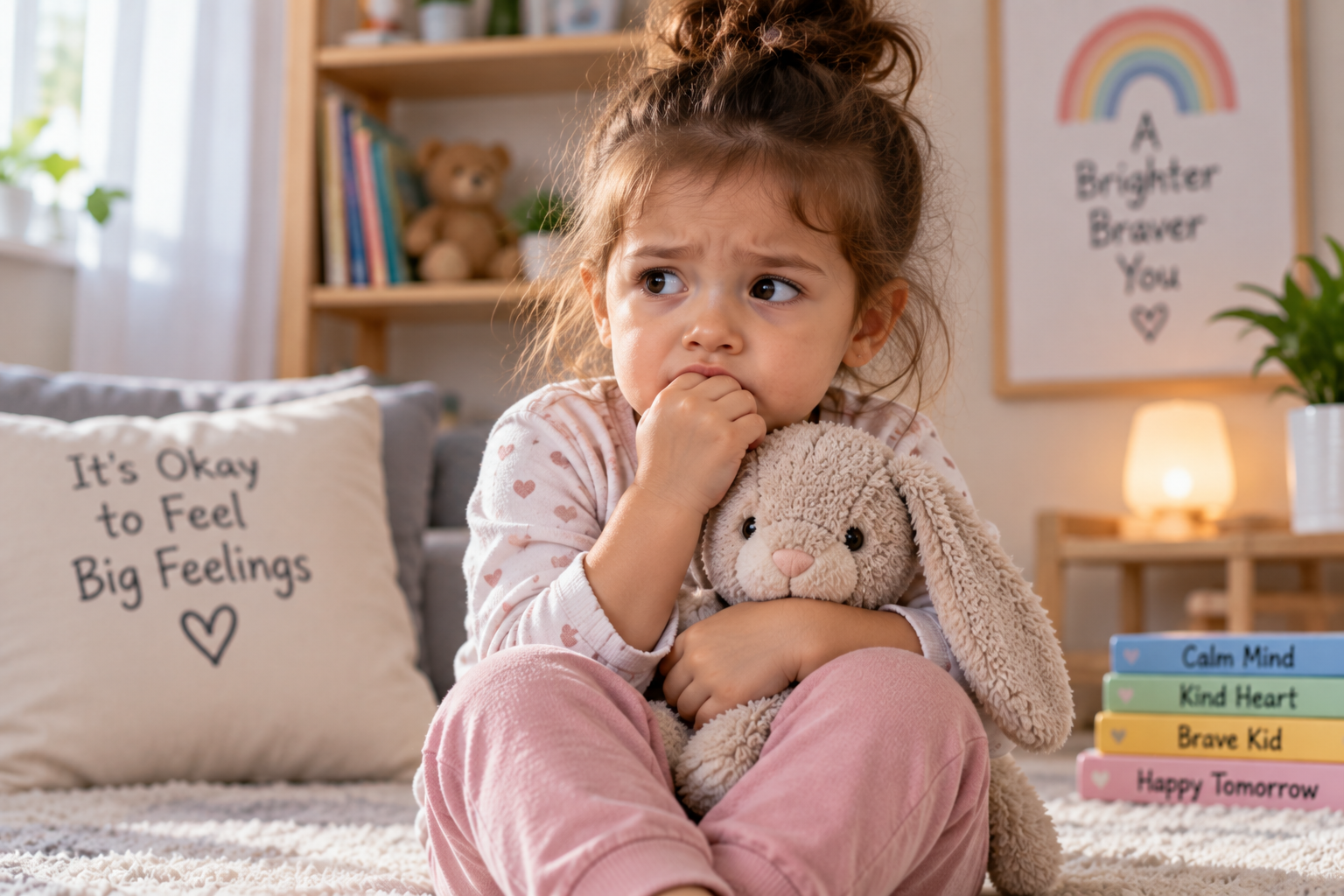
It’s 8:47 p.m. and your child is asking, for the third night in a row, whether the house could catch fire. You’ve reassured her. You’ve checked the smoke detectors with her. Still, her eyes stay wide open, and your heart breaks a little more each time.
Watching your child struggle with worry is one of the hardest parts of parenting. You can’t fix it for them, and telling them “there’s nothing to worry about” rarely helps. What does help is knowing how to help a child deal with anxiety in ways that build their confidence instead of feeding the fear.
The good news is that anxiety in children is very treatable, and you don’t need a psychology degree to make a real difference. Small, consistent changes at home can shift how your child responds to worry.
In this post, you’ll find practical strategies you can start using today, from calming techniques that actually work to the words you should (and shouldn’t) say when anxiety shows up.
What Anxiety in Children Actually Looks Like
Adult anxiety often announces itself. Adults say “I’m stressed” or call in sick. Children rarely have the words for what they feel, so anxiety comes out sideways: as a stomachache, a meltdown over socks, or sudden refusal to go to school. That’s why recognizing it is the first skill you need. Once you know what to look for, worry stops being invisible.
Common Signs of Anxiety in Kids
Anxiety shows up in three main ways: in the body, in emotions, and in behavior. Most anxious children display a mix, and the mix changes with age.
Physical signs are usually the first clue parents notice. Anxious kids frequently complain of stomachaches and headaches, especially on Sunday nights or school mornings. Trouble falling asleep, nightmares, and bedwetting after being dry for months are also common. If the doctor finds nothing wrong but the complaints keep coming, anxiety is a likely culprit.
Emotional signs include constant “what if” questions, irritability, tearfulness, and a need for constant reassurance. A worried child might ask the same question ten times even after you’ve answered it.
Behavioral signs tend to be the loudest. Watch for avoidance, clinginess, meltdowns before unfamiliar events, or a sudden refusal to do things they used to enjoy.
Age matters too:
- Preschoolers often regress: thumb-sucking returns, separation gets harder, tantrums spike.
- School-age kids complain of feeling sick, avoid playdates, and obsess over mistakes on homework.
- Tweens and teens may withdraw socially, overthink everything, or struggle with perfectionism and school refusal.
The CDC’s data on childhood anxiety shows diagnoses have risen steadily, and many kids go untreated simply because adults miss the signs.
Typical Worries vs. Something More
Every child worries. Fear of monsters, jitters on the first day of school, and nervousness before a recital are all normal parts of growing up. In fact, a little worry helps kids learn to handle the world.
So when should you be concerned? Look at three things: persistence, intensity, and interference.
A worry becomes a problem when it sticks around for weeks, when your child can’t be comforted even with your support, or when it starts disrupting daily life. Skipping birthday parties, losing sleep most nights, melting down daily at school drop-off, or refusing to eat are red flags. The American Academy of Pediatrics notes that anxiety lasting more than a few weeks and interfering with school, friendships, or family life deserves a closer look.
A quick rule of thumb: normal fears fade with reassurance and time. Anxiety disorders grow despite it. If your child’s worry keeps escalating or shrinking their world, it’s time to talk with your pediatrician. And if you’re unsure how serious it is, our guide to understanding childhood anxiety disorders walks through the differences in more detail.
How To Help A Child Deal With Anxiety at Home
Home is where your child’s anxiety gets tested most. It’s also where they build the tools to beat it. You don’t need a therapy office or a special program to make progress. What you need is consistency, patience, and a handful of strategies that work with how a child’s brain actually handles fear. Here’s your toolbox.
Teach Simple Calming Techniques
Anxious bodies run hot: fast heartbeat, shallow breathing, tense shoulders. Before a child can think clearly about a worry, their body has to settle. That’s why calming skills come first.
Try teaching these at a calm moment, not mid-meltdown. Practice makes them automatic when fear actually hits:
- Balloon breathing: Have your child breathe in slowly for four counts, pretending to inflate a belly balloon, then out for six. The long exhale switches on the body’s relaxation response.
- Five senses grounding: Name five things you see, four you can touch, three you hear, two you smell, one you taste. This pulls attention out of the worry and into the room.
- Muscle relaxation: Squeeze fists tight like lemons for five seconds, then release. Work through arms, legs, and face.
A useful comparison as you teach these: slow breathing is the brake pedal, and worry is the accelerator. Kids get the metaphor quickly, and it gives them language for what’s happening inside them.
The Child Mind Institute offers excellent breathing exercises for anxious kids that pair well with what you practice at home.
Create Predictable Routines
Anxiety thrives on uncertainty. A predictable day tells your child’s brain what’s coming, so it spends less energy scanning for threats. You don’t need a rigid schedule, just reliable anchors.
Morning, after-school, and bedtime are the big three. A visual chart with pictures works well for younger kids; a simple checklist on the fridge suits older ones. Bedtime matters most, because tired brains worry harder. A wind-down sequence (bath, book, dim lights, quiet chat) signals safety before sleep.
Transitions deserve extra attention. A heads-up like “in ten minutes we’re leaving for practice” prevents the jolt that triggers meltdowns. Changes to the routine, like a dentist visit or a substitute teacher, are worth previewing the night before.
Name the Feeling Without Feeding the Fear
When your child spirals, the instinct is to say “don’t worry about it.” But dismissing a fear teaches a child that feelings are shameful and must be hidden. Acknowledging the feeling, without amplifying it, is the sweet spot.
Try language like:
- “I can see this feels really big right now.”
- “Lots of kids worry about that. You’re not the only one.”
- “That sounds scary. Tell me more about it.”
Then resist the urge to solve. Instead, get curious: “What do you think would help?” A child who comes up with their own plan feels capable, and capability is the opposite of anxiety.
Naming a feeling reduces its intensity. Brain imaging studies at UCLA show that putting emotions into words calms the amygdala, the brain’s alarm center.
Let Them Worry, Then Let Them Cope
Here’s a counterintuitive one: don’t remove every source of anxiety. If your child fears the dark and you leave every light on forever, the fear gets more power. If you skip every birthday party they dread, their world shrinks.
The goal is supported exposure. Let them face the worry in small, manageable steps while you stay present. Afraid of answering questions in class? Role-play it at home first, then aim for one hand raised per week. Fear of dogs? Start across the street from a leashed pup, not in the petting zoo.
Praise effort, not outcomes. “I saw how nervous you were and you stayed anyway” builds more confidence than any trophy. That process, facing a fear and surviving it, rewires the brain’s alarm system better than reassurance ever will. Our post on building confidence in anxious children expands on this step-by-step approach.
Model Healthy Handling of Stress
Your child studies you constantly. If you catastrophize traffic, announce your dread of the work week, or bite your nails before flights, they absorb the script. Kids learn coping by watching, not by listening to lectures.
That doesn’t mean hiding every struggle. Say your worry out loud and then show the fix: “I’m nervous about this meeting, so I’m taking three deep breaths before I walk in.” That one sentence teaches more than a month of advice. Admitting mistakes helps too; when you snap at them after a rough day, apologize and name what you’ll do differently next time.
Know When Home Strategies Aren’t Enough
These tools help most children, but they’re not a cure-all. If anxiety persists for weeks, keeps your child out of school, causes panic attacks, or shrinks their life despite your best efforts, bring in a professional. Cognitive behavioral therapy (CBT) has strong evidence behind it for childhood anxiety, and a pediatrician is a good first call for a referral.
Seeking help isn’t a failure of your home strategies. It’s adding a specialist to the team you’ve already built.
Save pin for later


- Signs Your Baby Is Ready For Solid Foods - September 23, 2026
- First Trimester Survival Guide For Working Moms - September 23, 2026
- White Noise For Babies: Does It Really Help? - September 23, 2026