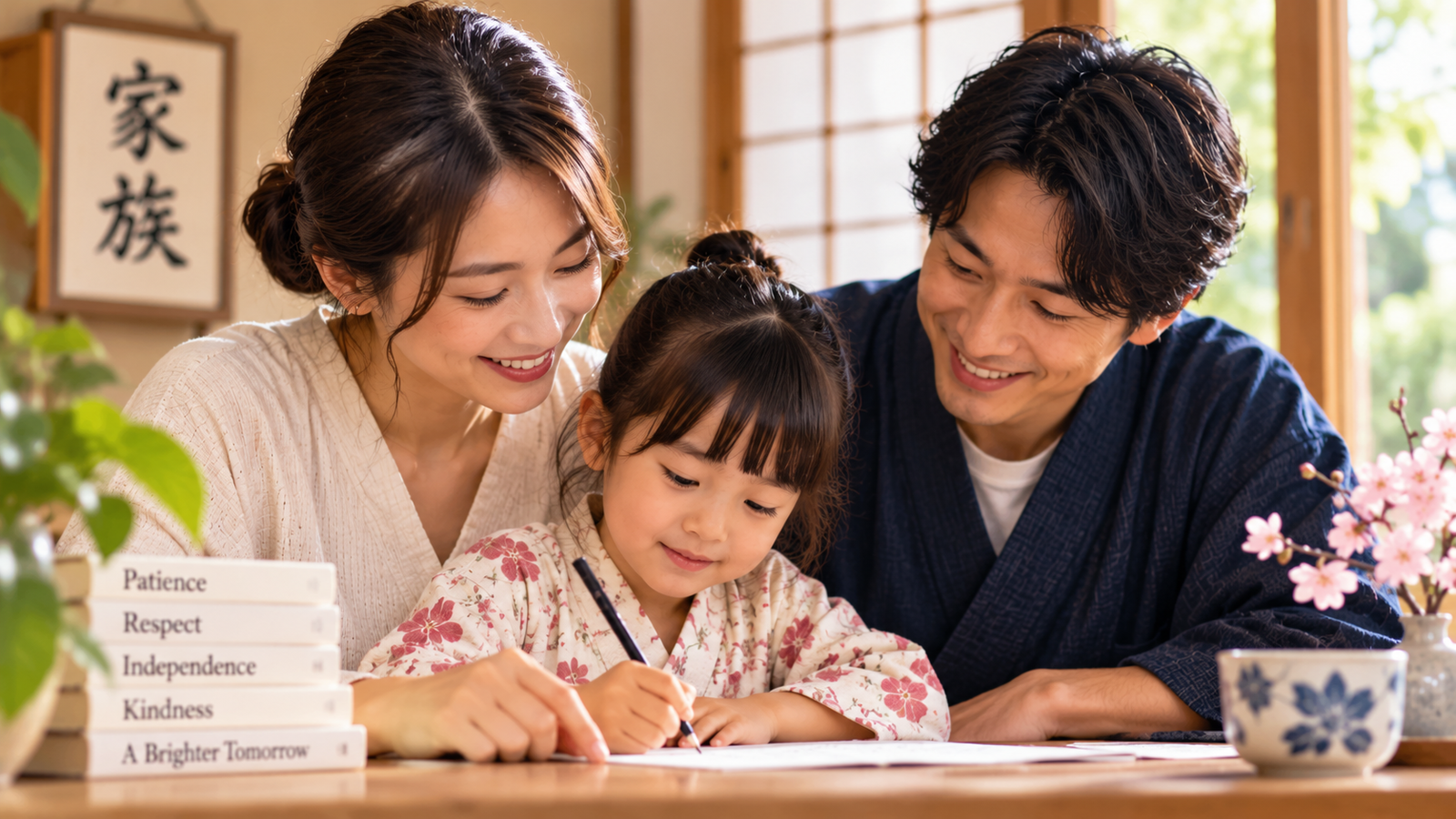
A five-year-old in Tokyo packs her own school bag, checks her schedule, and walks to the front door without being asked. Her parents didn’t hire a coach or buy an app. They raised her this way, one small habit at a time.
Japanese parenting draws attention around the world because its results are hard to miss. Kids there greet adults with respect, clean their own classrooms, and often run errands alone by first grade. Many families wonder how the same culture produces such calm, capable children.
The good news is you don’t need to move to Japan or speak the language. These 7 good upbringing steps from Japanese parents work in any home, and you can start using them this week.
Why Japanese Parenting Styles Work: The Philosophy Behind Japanese Parenting
Before you borrow any of the steps, it helps to see the beliefs underneath them. Japanese parenting isn’t a list of tricks you can copy-paste into your home. It rests on a few core values that shape every choice parents make, from how a child packs a bag to how a whole class cleans a floor. Once you understand those values, the steps that follow will feel less like rules and more like common sense.
The foundation is simple to state. Children grow best in an atmosphere of group harmony, mutual respect, and gradual independence. There are no harsh punishments or strict behavioral codes holding it up. Instead, parents model behavior, involve the community, and let responsibility arrive one small piece at a time.
The Cultural Roots You Should Know First
Three cultural ideas explain most of what looks mysterious about Japanese parenting from the outside.
First is wa, or group harmony. Japanese families teach children early that their actions affect everyone around them. A child who leaves toys on the floor isn’t just being messy; she’s making extra work for someone else. This creates the famous “don’t burden others” mindset. It sounds strict, but in practice it produces kids who clean up, help out, and notice other people’s needs without being told.
Second, praise goes to effort, not talent. A Japanese parent is far more likely to say “you worked hard on that” than “you’re so smart.” Psychologist Carol Dweck’s research at Stanford shows why this matters: children praised for effort keep trying after failure, while children praised for ability often give up to protect their image. Japanese parents arrived at this insight through culture rather than studies, and they apply it to everything from learning chopsticks to riding a bike.
Third, childrearing is a community effort. Japan has long operated with an “it takes a village” mindset, formalized in the proverb hitori de naran, ko wa furusato no te de sodatsu (a child grows with the hands of the whole hometown). Neighbors watch out for local kids. Teachers and parents treat each other as partners rather than adversaries. Schools reinforce at home what parents teach at school, so children hear one consistent message instead of two competing ones. If you want a closer look at how this partnership plays out in daily life, this overview of Japanese parenting culture breaks it down well.
None of these ideas require a passport. A parent anywhere can emphasize harmony, praise effort, and line up the other adults in a child’s life around the same goals. That’s exactly what the seven steps ahead show you how to do.
7 Good Upbringing Steps From Japanese Parents You Should Know
The philosophy is the “why.” Now here’s the “how.” Japanese parents build capable kids through seven repeatable habits, and none of them demand extra money or hours of your day.
Here’s the full set at a glance:
- Teach independence early, even at age 4
- Build empathy through everyday group life
- Correct gently instead of shouting
- Give kids real responsibilities at home
- Praise effort, not just results
- Let natural consequences do the teaching
- Model the behavior you want to see
Each step below comes with practical ways to start, whether your child is a toddler or a fourth grader.
Step 1: Teach Independence Early (Even at Age 4)
In Japan, children as young as 4 or 5 walk to school, ride trains, and run small errands alone. The Netflix series Old Enough! made this famous worldwide, showing toddlers sent on their first solo missions while neighbors quietly watch from a distance.
The secret is that parents never start with the full trip. They train it in stages: walk the route together for weeks, then follow a few steps behind, then let the child lead while you shadow them. Trust gets built in layers.
To start in your own home, try this:
- Pick one safe, short errand, like buying milk at a corner store.
- Walk the route together several times and talk through the steps.
- Let your child carry the money and do the talking next visit.
- Gradually hang back more each time until they go alone.
Independence is a skill, and skills need practice.
Step 2: Build Empathy Through Everyday Group Life
Japanese parents treat omoiyari, or empathy and consideration for others, as a skill to practice rather than a trait kids are born with. Japanese schools reinforce it daily. Students clean their own classrooms, serve school lunches to classmates, and work in small groups where everyone has a role.
You can create the same effect at home. Do chores together instead of assigning them separately, since shared work teaches children that the household runs on everyone’s contribution. When a conflict happens, ask “how would they feel?” instead of only punishing the behavior. You might also try a weekly family meeting where each person shares one thing that went well and one thing that was hard for them.
Empathy grows from repetition, not lectures.
Step 3: Correct Gently Instead of Shouting
Yelling is rare in Japanese households. Parents get physically close to the child, lower their voice, and explain why the behavior matters. Anger is saved for serious safety issues, so when it does appear, it carries real weight.
Gentle correction still needs firmness. The goal is calm, clear communication, not letting everything slide. Try swapping common shouts like these:
- “Stop running!” becomes “Walk please, the floor is slippery.”
- “I told you a hundred times!” becomes “Let’s try that again the right way.”
- “You never listen!” becomes “I need your eyes for a second.”
Lower volume actually increases attention. Children lean in when you lean down.
Step 4: Give Kids Real Responsibilities at Home
Japanese children pack their own bags, carry their own gear, and help at home from preschool age. Having a real role in the family tells a child “you matter here,” and that message builds confidence faster than any compliment.
Tasks should grow with the child:
| Age | Reasonable responsibilities |
|---|---|
| 3 to 4 | Put toys away, carry their plate to the sink |
| 5 to 6 | Pack their school bag, water plants, fold simple laundry |
| 7 to 8 | Set the table, sweep, help cook simple meals |
| 9 to 10 | Do their own laundry, prepare one easy dish, care for a pet |
Resist the urge to redo their work. A wrinkled towel folded by a five-year-old is a win.
Step 5: Praise Effort, Not Just Results
Japanese classrooms open each morning with a greeting ritual where students acknowledge one another, and perseverance, called gaman, is praised from an early age. The message is consistent: sticking with something hard is what earns respect, not natural talent.
So swap labels for observations. Instead of “you’re so smart,” say “you kept trying until the puzzle fit.” Instead of “you’re a natural,” say “you practiced every day this week, and it shows.” A few effort-focused phrases worth keeping handy:
- “You worked so hard on that.”
- “I noticed you didn’t give up.”
- “You improved so much since last month.”
Effort-focused praise keeps kids trying after failure, which is where the real learning happens.
Step 6: Let Natural Consequences Do the Teaching
Rather than warning ten times, Japanese parents often let one small, safe mistake speak for itself. A child who forgets homework faces the teacher’s response. A child who refuses a jacket feels cold hands and grabs it next time.
The parent’s job is deciding which lessons are safe to outsource to reality. Forgetting an item, missing a small deadline, or feeling discomfort from a choice are all fair game. Safety issues, of course, are different; those call for instant intervention, every time.
Your stomach may ache watching the lesson unfold, but stay quiet. The memory of a natural consequence lasts far longer than the memory of a nag.
Step 7: Model the Behavior You Want to See
Japanese children learn greetings, gratitude, and tidiness mostly by watching. Families eat together and say itadakimasu before meals, thanking the food and the people behind it. Parents greet neighbors, return borrowed items promptly, and put things back where they belong, and the children absorb all of it.
This is the most demanding step because there’s no faking it. If you want a child who says thank you, say thank you to them and in front of them. If you want tidiness, let them see you tidy.
The good news is consistency beats perfection. Small habits repeated daily will outperform any perfect parenting week followed by a month of slippage.
How to Apply These Japanese Upbringing Steps in a Western Home
Reading all this, you might be thinking your life looks nothing like a Tokyo family’s. You have a commute, soccer practice, two working parents, and a kid who negotiates bedtime like a lawyer. The steps still work, but they need adjusting. Think of them as ingredients rather than a recipe; you adapt the amounts to your kitchen.
Here’s how to handle the three most common worries.
“My neighborhood isn’t safe enough for a 5-year-old to run errands”
Skip the solo errands and keep the training method. Independence in Japan is built through gradual release, and that works anywhere. Let your four-year-old walk to the neighbor’s door alone while you watch from the driveway, or order and pay for their snack at the counter while you stand back. The confidence comes from doing things without your hands-on help, not from distance.
“Our culture celebrates individuality, not group harmony”
Wa and Western individualism clash less than they seem. Japanese parenting doesn’t squash a child’s personality; it teaches that personal freedom comes with awareness of others. You can absolutely raise an opinionated, expressive kid who also loads the dishwasher and notices when someone’s had a hard day. Frame it as teamwork rather than obedience, which most Western kids respond to anyway.
“Screen time is a constant battle”
Japanese families aren’t screen-free, but screens rarely fill unstructured time because children have real jobs to do. A child busy packing her bag and feeding the cat has less room for a tablet. If you want structured support for this, these simple family routine ideas pair well with the steps above and help screens find a smaller slot in the day.
One more thing: don’t attempt all seven steps at once. Pick the one that fits your biggest current frustration, practice it for a month, then add another. Japanese parents play the long game, and so should you.
Mistakes Parents Make When Trying Japanese-Style Upbringing
Borrowing another culture’s parenting approach is a great instinct, but the copy-paste version often backfires. Here are the mistakes that trip parents up most, and how to sidestep them.
Copying the Rules Without the Warmth
Japanese parenting looks strict from the outside, but it runs on closeness. Kids cooperate because they feel connected to their parents, not because they fear them. If you import the expectations (clean up, be polite, don’t burden others) without the warm daily connection behind them, you get resentment instead of cooperation. Spend the connection time first; the rules only stick when the relationship is strong.
Expecting Instant Politeness
Japanese children didn’t become calm and courteous overnight. Their behavior comes from years of modeling, repetition, and gentle correction. If your six-year-old says thank you like a hostage after two weeks of effort, that’s normal. Think in months and years, not days, and celebrate small wins along the way.
Overloading Kids With Responsibilities
Real chores build confidence; too many build exhaustion. Japanese parents give small, age-appropriate jobs and treat them as contributions, not labor. If your child is suddenly doing more housework than you, scale back. The goal is a child who feels valued, and a burned-out child doesn’t feel anything good about helping.
Comparing Your Child to a Japanese Stereotype
The tidy, self-sufficient Japanese kid you see online is a highlight reel, not a census report. Japanese children whine, forget things, and test boundaries just like every other child on earth. Use these steps as direction, not as a measuring stick. Your child’s progress matters more than any idealized picture you’ve seen.
Conclusion
Japanese parents raise capable kids through seven steady habits: early independence, everyday empathy, gentle correction, real responsibilities, effort-focused praise, natural consequences, and strong modeling. None of them cost money, and none require a perfect household.
The strongest takeaway is consistency. Pick one step, practice it for a month, then add another. Small habits repeated daily beat any grand plan you abandon by Friday.
So, which step will you try first this week?
Save pin for later


- 10 Things You Shouldn’t Do in Front of Your Baby (and What to Do Instead) - September 22, 2026
- 15 Effective Ways to Deal With Stubborn Children (Without Yelling) - September 22, 2026
- Birth Order Influence: 8 Things Parents Should Know About Each Child - September 22, 2026